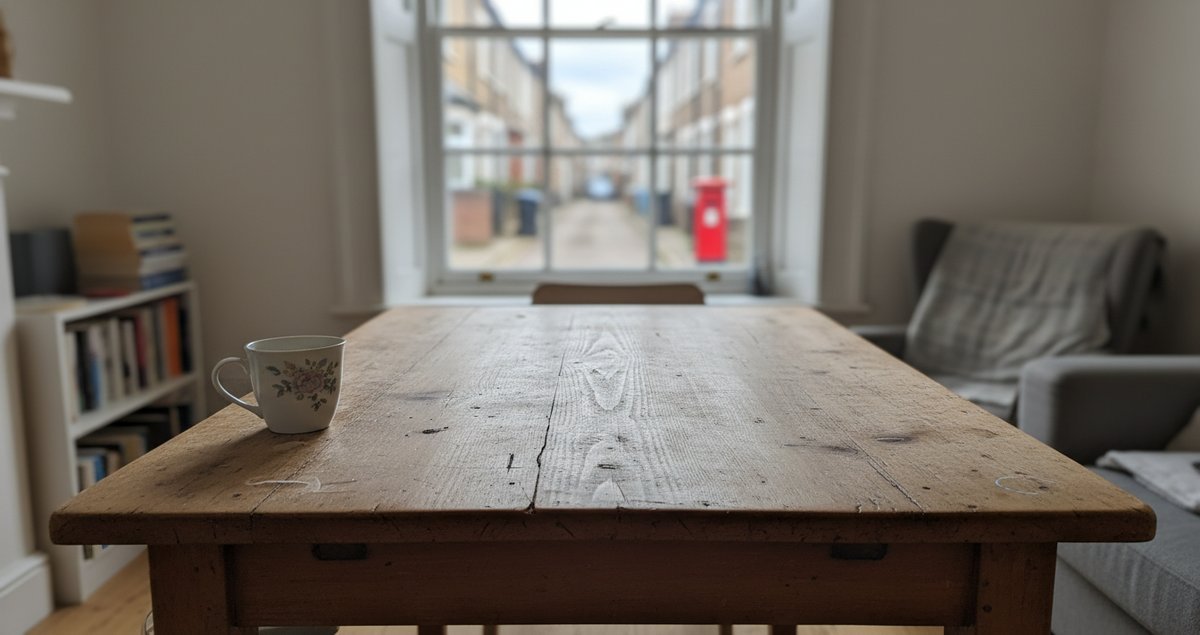
There is something quietly strange about walking through new developments and noticing the same gap again and again. A neat two bedroom flat marketed as lifestyle living. An open kitchen that flows into a sofa and a pancake of an island. No dining table. Not a corner for one. Just a ledge, a stool, a suggestion that meals will be brief and private. The disappearance of dining tables is not a single design choice. It is a social contour line that reveals how we now live in rooms that were once designed to make us sit down together.
Where the furniture went
Start with the obvious. Space is finite. Developers and buyers have decided that those square metres are better used for wardrobe depth and bed size than for a piece of furniture that, in many households, is used three times a year. That alone would not explain the trend. Houses in Britain were not always built around islands and media walls for trivial reasons. The dining table once held social weight. It was the place where rituals of arrival and departure were enacted. It was where guests were measured and married couples performed domestic competence. Now those rituals have loosened. The table has become a ritual without practitioners.
Design follows habits not the other way round
Architects will tell you that form follows function. The function has shifted. Open plan living brings visual air and promotes cross talk between cooking and lounging. But the same open plan also dissolves where meals happen and who witnesses them. The kitchen island is performative not familial. It invites quickness. Dining tables invited investment of time and attention. The island asks for speed and multitasking.
Technology is not just a spoiler it is a rewriter
People eat at screens. This is not simply teenage indifference. Adults do it too. Teleworking has spread the habit of consuming food while reading or joining a meeting. The table is awkward to a device centred life. You cannot prop your laptop on a formal dining table and disappear into work without making the house feel like an office. So the table is either repurposed or removed. On a cultural level this is significant. The ritual of eating together used to be a spatial anchor for conversation and attention. When the anchor lifts the conversations drift into short messages and fragmented attention.
Dr Elizabeth Kilbey psychologist The Week Junior and independent researcher explains that family mealtimes are fraying and that many households now avoid difficult conversations at the table.
The quote above is not here to moralise. It is to note that the loss of the table has cognitive and conversational consequences. Meals become functional acts rather than gatherings that order the day.
Economics and taste collide
There is a merciless economy behind this trend. Square footage has economic value and every centimetre must earn its keep. Closets and extra bathrooms command resale returns more certainly than a rarely used dining room. That is why you see the trade off. The table becomes the sacrificial lamb of market logic. But taste matters too. One generation values a multifunction sofa and a glossy island because it fits their life. Another still longs for a table to anchor a sense of belonging. Both are valid. I personally find the loss melancholic and practical at once. Some of my happiest meals have been at a battered table where the surface carried stories. That texture is harder to reproduce on a sleek island.
Bobby Fijan real estate developer and floor plan expert New York based points out that dining rooms occupy square footage and that space can be allocated to more valued features.
An uneven nostalgia
Nostalgia for the dining table is not universal. For single people and small households a permanent table is an inefficient piece of furniture. For those who still love ceremony and hosting the table is a vital stage. This produces a geography of difference across cities and neighbourhoods. In parts of London where flatshare culture dominates the table is functionally irrelevant. In older suburbs the table persists as a marker of continuity. The vanishing table therefore is not disappearance per se but redistribution of ritual into different places.
Domestic labour and gendered history
We cannot discuss the dining table without the echo of work that once accompanied it. When housework was less shared the dining room was a room of display and of hidden labour. Its decline tracks shifts in gender roles and in who prepares food and who is expected to host. The table used to stage a performance of domestic competence. Now performance is redistributed across social media and to the kitchen island where cooking is visible. The consequences are mixed. Visibility can democratise labour but it can also turn care into content.
What replaces the table
Sometimes nothing replaces it. Chairs stack in cupboards and surfaces become temporary platforms. Other times the replacement is subtle. Window seats become eating nooks. Communal counters host breakfast rituals that are fast and functional. In some homes the dining table is replaced by the sofa where people eat in private and watch the same show. Oddly the table’s absence can make the home feel both freer and lonelier at once.
Designers react creatively
Designers respond with hybrid pieces. Fold away tables that appear for dinner and vanish the rest of the week. Tables that double as desks. These are clever responses but they underline the same point. The table is no longer a default. It is a choice. The choice reveals what a household values. That is where I feel an emotional dissonance. I admire people for choosing space for rooms they use every day. But I also miss the intentionality a dedicated table demanded.
Why this matters beyond furniture
Objects can be proxies for social life. The removal of the dining table is a small visible symptom of broader changes. People are more mobile. Family structures are more varied. The rhythms of the day are less synchronised. These are neither inherently good nor bad. Yet they shape how people negotiate proximity and conversation. The table had a stubborn ability to make people stop and sit. Its loss reduces those gentle constraints which sometimes did the work of care.
Not everything about this change is loss. Some households find freedom in not being forced into ritual. Other households create new rituals that have different shapes. The problem is when choices are made by default because of market pressure or because screens have made attentiveness harder. If we want to keep the table we have to choose it. Not as décor but as a commitment to an hour of shared attention.
What to do if you miss it
Consider the practical and the symbolic. A small round table can hold as much meaning as a large one. Scheduling one meal a week matters more than the size of the surface. And if you must keep an island try insisting it be used for more than snacking. Ritual needs scaffolding not relics.
Parting thought
Dining tables are vanishing not because furniture designers conspired but because our lives have rearranged themselves. This is social architecture at work. If you read this and feel a small tug of loss that is evidence that those surfaces carry memory work. That tug can be a prompt. It can make us think about what we want to preserve and what we are happy to trade for convenience. There is no single answer. The table might return as a deliberate act of resistance or be reinvented into something lighter and more adaptable. Either outcome will tell us something about who we become next.
Summary
| Key idea | What it reveals |
|---|---|
| Space economics | Market preferences prioritise bedrooms and storage over a formal table. |
| Technology | Devices reconfigure where and how meals are eaten. |
| Social ritual | The table once anchored conversation and now it often does not. |
| Design responses | Hybrid furniture and islands are emerging as functional compromises. |
| Cultural choices | Keeping a table is an intentional practice not an accident. |
FAQ
Is the dining table actually gone for good?
No. The dining table is not extinct. It is changing in prevalence and meaning. In some households the table has been replaced by new rituals and in others it remains central. Expect to see it persist where social cohesion and hosting are priorities. Its decline is uneven and contextual.
Are developers to blame for removing dining rooms?
Partly. Developers respond to market demand and to the economics of space. When buyers prefer larger bedrooms and open living areas developers build what sells. Blame is too simple a frame. Homes also reflect cultural habits which are shifting independently of developer choices.
Can small tables encourage family meals?
Yes. A compact round table or a foldable solution can create the conditions for shared meals without requiring a lot of space. Ritual beats size. Intention and frequency of use are more likely to revive the practice than the grandeur of a table.
Does technology make the table irrelevant?
Technology changes meal patterns but it does not make rituals impossible. Devices compete for attention. If a household decides to enforce device free meals the table can regain its role as an anchor for conversation. Technology has altered the terms but not erased the possibility.
What does losing the table reveal about wider social change?
The trend highlights changing household composition increasing mobility and altered work patterns. It is a visible marker of how intimate life has been reorganised. The table is a lens through which to see shifting priorities about time attention and domestic labour.
How can I bring the table back without major renovations?
Start small. Make one meal a week a table meal. Create a visible change of setting at that hour. Use a small or extendable table that stores easily and reintroduce the choreography of dining. Ritual is about repetition not furniture alone.
