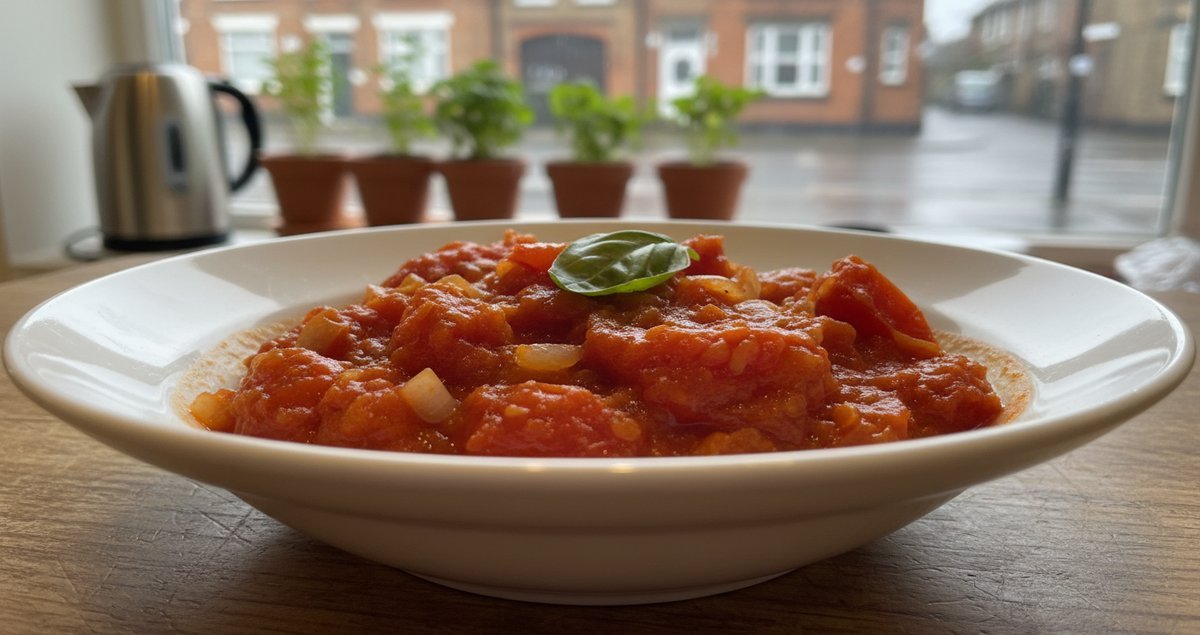
I am going to admit something small and selfish right away I like sauces that look like someone loved them into existence not like they were engineered in a test kitchen. That is precisely why I love the no equipment pasta sauce I am writing about here. It asks nothing of you except a pot a wooden spoon and a little patience. It gives back a depth that most jarred sauces only pretend at.
Why this sauce feels impossibly rich despite no tools
People imagine richness as a list of ingredients browned and rendered and fussed-over. In reality richness can live in concentration texture and in the confident use of contrast. This sauce is simple tomatoes slowly coaxed into velvet with nothing more than heat and time. No blender no food processor no expensive olive oil. The trick is letting the tomatoes reorganize themselves into something more than they began as.
The quiet chemistry behind the flavor
Ripe tomatoes bring an innate savory note that often gets lost when we rush. As Harold McGee the author of On Food and Cooking notes ripe tomatoes contain an unusually large amount of glutamic acid which translates into that meaty umami feeling. This is not a magic wand moment it is a molecular fact that you can exploit by time and temperature rather than gadgets.
“Ripe tomatoes have an unusually large amount of savory glutamic acid as much as 0.3 percent of their weight.” Harold McGee author of On Food and Cooking Yale University press.
That quote is not a prescription it is an invitation. If you let the tomatoes sit and reduce the savory components concentrate and the personality of the sauce changes from bright to substantial. I prefer starting with good tinned tomatoes when the weather in Britain denies us sun ripeness, but the technique works with fresh homegrown fruit too.
A fast recipe with no tools and an opinion about timing
Start in a wide heavy pot. Sweat an onion until it softens not until it browns. Add whole tinned tomatoes crush them with the back of a ladle or a wooden spoon and simmer low. The choice to avoid emulsifiers or binders and to skip blitzing is deliberate. I want texture pockets tiny threads of tomato and a sauce that clings rather than slides off. Stir occasionally and leave it alone more than you think you should. Sixteen to forty minutes of steady simmer will do different things and both are valid. If you rush it you will get acidic one dimensionalness. If you overdo it you will find jammy intensity that might not suit the pasta you have. Calibrate to mood.
On adding fat and starch at the end
There is an important last act where the sauce stops being a sauce and becomes a partner. J. Kenji López Alt of Serious Eats has repeatedly emphasized that adding a little fat and a spoonful of starchy pasta water at the finish changes the mouthfeel and helps the sauce cling. This is not cheating it is seasoning the texture. I do not use much butter but a spoonful does wonders. A splash of pasta water is the only emulsifier you need.
“If you have a very low fat sauce like a tomato sauce now is the time to add extra fat a small amount of fat like extra virgin olive oil or butter is essential to good pasta sauce texture.” J Kenji López Alt Chief Culinary Consultant Serious Eats.
There are people who will insist olive oil must be of a certain pedigree. I will not be one of them tonight. Use what you have. The point is the fat not the prestige of the bottle.
Small moves that create the illusion of ceremony
Toast a garlic clove in the dry pan then remove it. Add the tomatoes. Drop a peeled carrot into the pot if you want a gentle sweetness that behaves like a background singer. Remove the carrot later. Try finishing with torn basil leaves and a tiny flourish of grated hard cheese if you like. These moves make the sauce feel considered without requiring equipment or a special ingredient list.
Why I refuse to seed tomatoes when I make this
Seeding tomatoes is a ritual in many family kitchens. It is fiddly and sometimes it reduces water content. I happily skip it. I prefer the little textural pops and the umami rich jelly around the seeds. You can remove seeds if you prize cosmetic smoothness but you lose a whisper of flavour in the bargain. I will take character over sterile uniformity any day.
Serving and matching opinions
This sauce loves short fat pasta shapes that trap sauce in their curves but it also marries well with long strands when you finish the pasta in the pan. I will always toss rather than drown. Simple green salad on the side no need for a construction of herbs and citrus. A glass of something red if you must. Serve warm and slightly sloppy. If you spread this sauce on toasted bread it will hold its own as a snack or a starter. It is versatile in the way a good conversation is flexible enough to survive interruption.
One confession
Once I blasphemously added a teaspoon of fish sauce near the end to a batch and watched a quiet crowd at dinner do that softening expression that means pact made between the food and the eater. You do not need to replicate that. This piece is about being armed only with your hands and a pot not exotic condiments. But the point is: small additions matter more than machinery.
Original insights you will not read everywhere
First insight: texture hierarchy. When you avoid pureeing you create contrast. Little islands of tomato skin or softened onion work as flavor release mechanisms over multiple bites. The sauce changes as you eat it because different pockets dissolve at different rates. That gives a sense of narrative to a single plate.
Second insight: the economy of restraint. Most home cooks confuse more ingredients with more flavour. The reverse is often true for tomato sauce. When you strip back and let the tomatoes dominate complemented by one or two supporting players you get focus. Focus eats distraction for breakfast.
Third insight: the sauce is a memory holder. This is less practical and more stubbornly human. When you cook a sauce in an empty kitchen with nothing else on the stove it accrues traces. The smell of onion that continues into the next day the slight caramel echo that on day three reads as nostalgia. You can call it sentimental but it will still be delicious.
When to break the rules
If you need sauce fast use crushed tomatoes and a high heat reduction and accept a different result. If you want a perfectly smooth restaurant style sauce then blend or pass through a sieve. I tend to break the rules only when I have company who will judge. Otherwise I let the pot do the talking.
Summary table
| Element | Why it matters | Quick tip |
|---|---|---|
| Tomatoes | Provide natural umami and acidity | Use tinned for consistency or ripe fresh when available |
| Heat and time | Concentrates flavor without gadgets | Simmer low and patient for best results |
| Fat and pasta water | Emulsify and help sauce cling | Add a spoonful of butter or oil and some pasta water at finish |
| Texture choices | Creates interest across bites | Resist pureeing unless you want smoothness |
FAQ
Do I need fresh tomatoes or are tinned tomatoes okay
Tinned tomatoes are perfectly fine and often preferable in Britain outside of summer. They tend to be picked ripe and processed quickly which locks in flavor. Fresh tomatoes are wonderful when they are genuinely sunripe. If you use fresh you may need a longer reduction to match the depth that tinned tomatoes offer.
How long should I simmer the sauce for best results
There is no single correct answer. Simmer for as little as sixteen minutes for a bright lighter sauce. Simmer for up to forty minutes or longer and you will get jammy concentrated flavours. The decision depends on what you want to pair with the sauce and how patient you are. Taste along the way and trust what your palate tells you not the clock alone.
Can I make this in advance and how does it reheat
Yes you can make it in advance. The flavours will knit together and the sauce often tastes better the next day. Reheat gently on the stove add a splash of water or pasta water to loosen the texture and finish with fresh herbs or a small pat of butter to revive brightness.
Will skipping a blender make the sauce rustic and unrefined
It will make it textured and honest. Rustic is not the same as sloppy. A no equipment sauce can be elegant in its restraint and the texture can add a pleasurable complexity to every bite. If you want absolute uniformity then pureeing is the right choice for you but that is a different dish.
What small ingredient changes dramatically affect the final sauce
A single peeled carrot added during simmering will bring gentle sweetness without making the sauce overtly sweet. A tiny splash of fish sauce will amplify umami but is optional. A knob of butter at the end rounds edges. These are incremental adjustments not wholesale transformations.
Is seeding tomatoes necessary
No it is not necessary. The jelly around seeds contains concentrated flavour. Seeding will make a cleaner texture but you will lose a little of the savory depth. Choose according to what you value more in the moment texture or absolute smoothness.
There are entire kitchen religions built around gadgets and assertive technique. This sauce is the quiet counterargument. It is a reminder that richness can be coaxed out of patience and modesty. It will not make you a better person but it will make dinner better.
