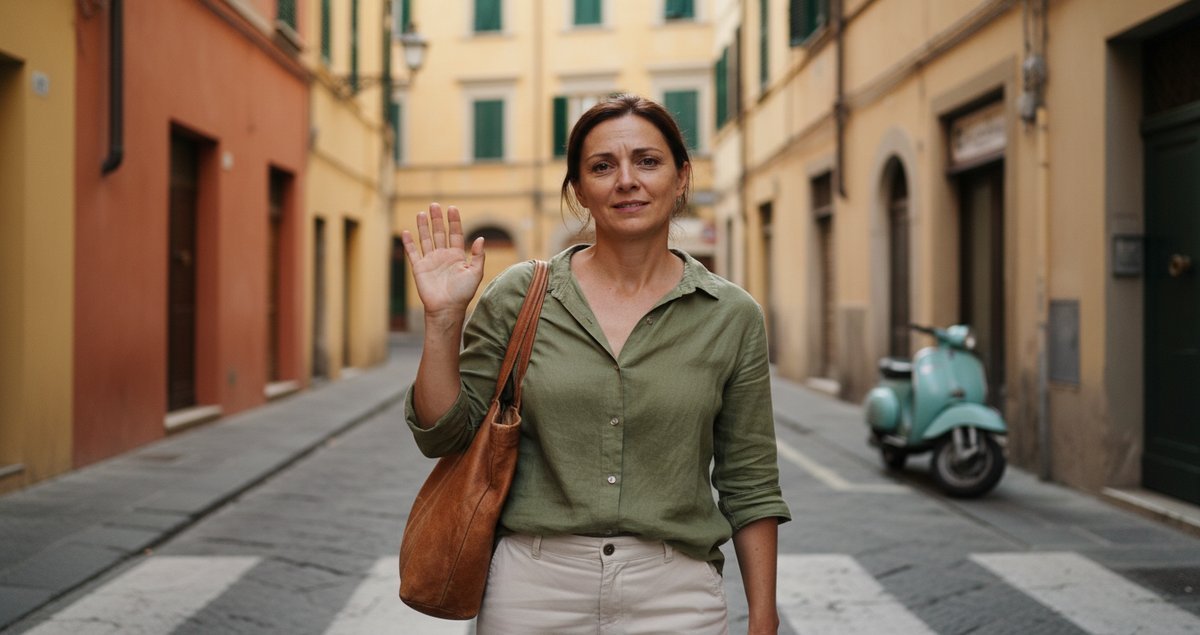
There is something strangely intimate about catching a driver with a raised hand while you step off the curb. It is too small to be a ritual and too frequent to be merely etiquette. We do it anyway. We nod. We lift a palm. We offer a half smile and sometimes a full mouthed thank you. The act is both trivial and revealing. It tells us who we are in traffic and how fragile our trust is with strangers moving at speed.
The tiny theatre of a crosswalk
Stand at almost any intersection and you will see an economy of gestures. A pedestrian makes a brief assertion of intent and a driver responds with a deceleration or a nonchalant glide. The exchange is raw and fast. It is not just mechanical risk calculation. Inside that second there is interpretation memory projection and judgement. We are scripting social meaning on asphalt.
What the gesture actually does
When you wave at a car you are doing more than saying thank you. You are marking territory. You declare temporal possession of the lane. You demand recognition. That recognition is not guaranteed by law or light alone. In a world of distracted attention the wave stands in for a missing guarantee. It is a human patch applied to a thinly supervised system of rules.
Researchers have long studied whether these small signals change driver behaviour or merely ease the pedestrian conscience. The literature is not tidy. Some experiments show a real change in stopping frequency while other studies suggest much of the pedestrian confidence comes from the vehicle slowing not from the mutual gaze. The nuance is important because it reframes the wave as both performative and practical.
“The results of the present study confirmed our hypothesis: at pedestrian crossings significantly more drivers stop to permit to a pedestrian to cross the street when he or she looks the driver in the eye.”
That is a real field finding. But it sits beside another inconvenient observation. Many crossings occur before a pedestrian can even see the driver well enough to judge gaze or facial expression. In those cases the wave is not an accurate signal of mutual recognition; it is an audition for attention that sometimes precedes vision.
“When asked a majority of people believe that as pedestrians they make eye contact with the driver of an approaching vehicle when making their crossing decisions. This work presents evidence that this widely held belief is false.”
Why we need a human fix for a mechanical world
Automobiles are engineered to be efficient not empathetic. They are metal boxes that obey physics first and social contracts second. That means human bodies must improvise. The greeting at the curb is part social glue part hazard signal and part private theatre where we rehearse a narrative about being seen. There is a civic generosity in it. You hand off your life to someone else for a fraction of a second and you do so by asking them to acknowledge you as a person not an obstacle.
The psychology behind the motion
From a psychological perspective the wave performs three roles simultaneously. First it is a request for clarity. Second it is an affirmation of moral personhood. Third it is a ritualized gratitude that reinforces social cooperation. Often these roles overlap. The wave can be both a command and a compliment. That ambiguity is what makes it powerful and confusing at the same time.
But there is an ironic twist. The meaning of the wave changes with context. In a sleepy suburb it might be taken as friendly. In a dense city it can be a hostile insistence. The same tiny motion can signal safety or entitlement. I have noticed that people who wave in cities often carry a different tempo in their step. It is impatient not warm. The gesture therefore betrays inner states as much as outward intention.
When waving is performative and when it is real
There is a performative layer to the greeting that researchers rarely reckon with fully. People thank drivers mostly when the driver slows. That is backward causality but it is human. We tend to produce politeness after a favourable outcome. That does not make the wave meaningless. It makes it contingent. Sometimes it acts like a social receipt acknowledging a favour received. Other times it is a proactive demand to be seen.
My own observation is that the most authentic waves are those that arrive before the car has fully stopped. They are messy quick and slightly awkward. They feel like someone clearing their throat to be heard. The most hollow waves are polished and habitual performed at high frequency like a ritualized checkbox. Habit does not always map to sincerity but it still signals culture.
Power dynamics and who gets waved for
Gender age and perceived vulnerability alter the likelihood of receiving a stop and a wave. In the studies discussed earlier drivers were more likely to stop for women than for men. That suggests our tiny signals exist inside larger hierarchies. When we wave we are not only asking a stranger to pause we are testing a social script that includes assumptions about who deserves deference and why.
I do not like the idea that politeness can mask inequality but such masking happens. A wave can be a cover for unequal expectations. We thank drivers who stop because society taught us to be grateful for small acts of accommodation rather than to demand safer infrastructure that would remove the need for gratitude in the first place.
Design implications and subtle futures
As cities debate smarter crosswalks and automated vehicle signals they must reckon with what these human gestures actually accomplish. Engineers can replicate the outward effect of a wave with LED eyes on an autonomous car or a digital sign that blinks when a human is detected. That might create the mechanical outcome of more stops. It might not replace the human reciprocity embedded in a brief nod. There are affordances that technology can mimic and others it cannot manufacture.
There is a larger ethical question. If we design cities so well that no one needs to wave will we lose an arena of daily interpersonal recognition or will we simply remove a brittle and risky mechanism of survival? The answer is not obvious and I lean toward insisting on safer streets for everyone rather than preserving the charm of a crosswalk salute.
A few practical observations I keep returning to
First there is the honesty of motion. A real wave is time sensitive. If you wave after the car has passed the point of decision it performs a different psychological function. Second the gesture scales with risk. The more uncertain the driver the more animated the wave. Third context matters enormously. A wave in torrential rain reads differently than a wave on a lazy summer afternoon.
I have waved too much and not at all. Both taught me the same lesson which is that these minor performances are part social contract part personal therapy. They help us believe in a world where strangers can cooperate even when cooperation is inconvenient.
Summary table
| Idea | What it means |
|---|---|
| The wave is a claim | It signals intent to occupy the crosswalk and requests recognition from the driver. |
| The wave is gratitude | Often given after a driver slows and acts as social receipt for the favour. |
| Eye contact research is mixed | Some studies show increased stopping with direct gaze while others note pedestrians often cannot see driver gaze when deciding to cross. |
| Context shifts meaning | Cultural and situational factors change whether a wave reads as polite impatient or entitled. |
| Design matters | Better infrastructure could reduce the need for the wave while technology may or may not replicate its social value. |
FAQ
Does waving actually make drivers stop more often?
There is evidence that a pedestrian who makes direct eye contact or a clear hand gesture can increase the probability a driver will stop. Field experiments have found measurable rises in stopping rates when pedestrians intentionally look at drivers. That said the effectiveness varies with visibility road design and the driver demographics. Additionally some rigorous studies show that pedestrians often begin crossing before they can reliably see the driver which complicates a simple causal story. The safest conclusion is that waving sometimes helps and is worth combining with safe crossing practices.
Is the wave more about feeling safe than being safe?
Yes and no. The gesture can increase a pedestrian’s subjective feeling of safety by creating a sense of mutual acknowledgement even when the objective change in vehicle behaviour is marginal. That subjective comfort is real and influences behaviour but it should not be relied upon in place of crosswalks traffic controls or attentive driving.
How does social inequality shape who gets the wave?
Studies indicate that demographic features influence driver responses. Drivers have been found to yield more often to women older adults and those who appear vulnerable. This means the wave is embedded in social expectations and biases. The crosswalk is a microcosm where broader social patterns repeat. Acknowledging that should make urban designers and policymakers cautious about relying on interpersonal gestures as safety mechanisms.
Will autonomous vehicles make the wave obsolete?
Autonomous vehicles can be programmed to yield and to signal intent. They can also simulate human acknowledgement with lights or displays. However the human reciprocity that comes from two bodies encountering each other is not easily replaced. Even if machines replicate the mechanical outcome the cultural habit of recognizing one another may persist for reasons beyond mere utility. In short machines could reduce the need for the gesture but they cannot entirely erase its social meaning.
What should a pedestrian do if the driver does not respond to a wave?
Slow down and reassess. A failed acknowledgment is information. It indicates either that the driver did not perceive you or chose not to yield. In either case pause observe vehicle kinematics and make a conservative crossing decision. The wave is a tool not a guarantee.
Is it better to wave or to make a bigger gesture?
Clarity matters more than elegance. A definitive clear motion timed before the car reaches decision point will do more to attract attention than a small polite hand movement performed too late. That said escalation into frantic gestures can confuse drivers. Use decisive moderate motion and pair it with eye contact when feasible.
