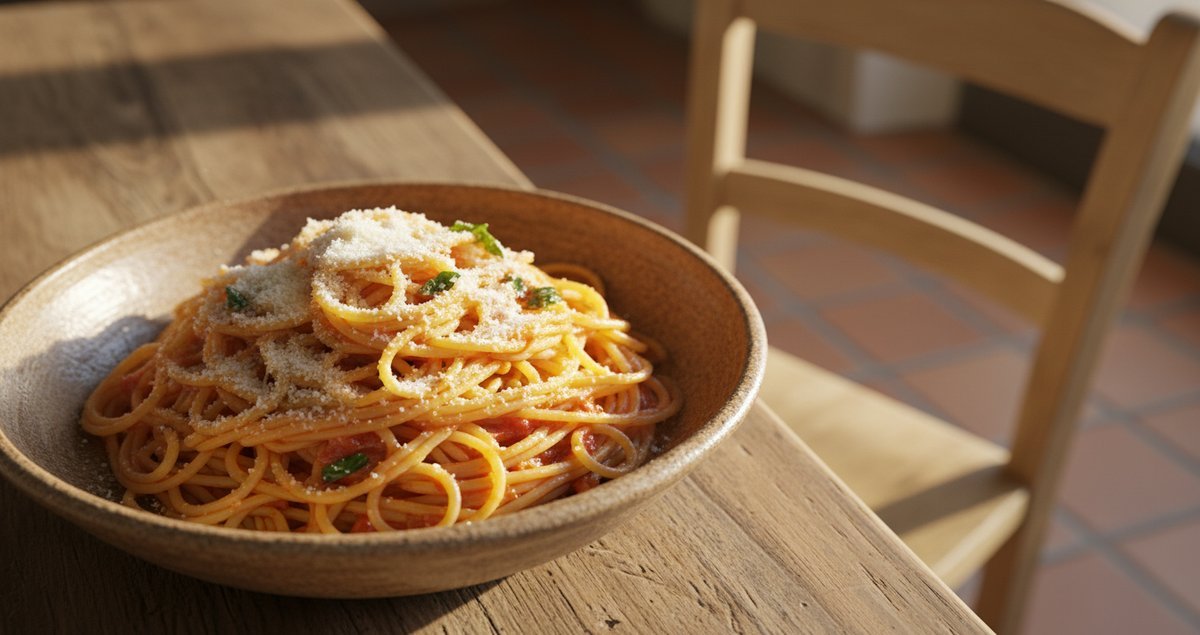
I am going to start blunt. Stop rinsing your pasta. Not because I want to be prescriptive about your sink rituals but because every time you strip that cloudy film off your noodles you are throwing away the single most useful ingredient in Italian ragouts and weeknight olive oil tosses alike. That milky water is not a nuisance. It is glue and silk and the quiet thing that makes a sauce behave with the pasta instead of simply sitting on top of it.
The small everyday mistake that makes your sauce slide off
Here is the common scene. You cook spaghetti. You pour it into a colander. You rinse to stop it sticking because someone told you pasta must not cling. Then you dump sauce on top and watch with a mild betrayal as the sauce pools in the bottom of the bowl. I have watched this enough times to suspect most of us were taught to rinse as an anxious cleanliness ritual. It is not about cleanliness. It is about texture chemistry.
Starch at the surface matters more than you think
When pasta cooks it releases two things into the boiling water. One is flavor from salt and whatever semolina the dough gives up. The other is starch. That starch collects on the surface of each strand and creates a microfilm that changes how liquids behave on the noodle surface. Remove it and sauces cannot form a stable marriage with the pasta. Leave it in place and a sauce will cling, meld, emulsify and finally taste like a unified bite instead of two separate components.
What the pros actually do
Professional kitchens do not waste that cloudy pot liquid. They steal it. They ladle it into pans, they finish sauces with it, and they toss it into the heat with a little cheese or butter to coax an emulsion. There is a reason the pasta stations at reputable trattorias never rinse their strands. The result is simple and stubborn. Better bite. Better mouthfeel. Better sync between the cooked wheat and the sauce.
Starchy pasta water is the perfect liquid for adjusting pasta sauces at the last minute. I do not know a single chef who throws this magical elixir down the drain until the night is over. Alton Brown Chef and Author Food Network.
A practical aside about timing
Do not confuse rinsing with shocking to stop cooking for a cold salad. If you are making a pasta salad then a quick cool rinse does make sense because you want to arrest the texture. But for hot dishes the right move is to lift the pasta directly into the sauce and finish the cooking there. That way the surface starch is still active and the sauce has an opportunity to bind to it.
Why it works the way it does
There are a few sensory and physical pieces to this. Starch helps thicken and acts as a small adhesive. It also helps emulsify oil and water phases. When you toss hot pasta with oil based dressings or cheese based emulsions the starch helps distribute the fat uniformly so you are not chewing a pocket of oil followed by a dry noodle. This is why cacio e pepe and aglio olio transform when you add reserved pasta liquid and toss. They become glossy, single entity sauces rather than a collection of ingredients pretending to be a meal.
Not every sauce needs the same amount
Here is a nuance that I do not see emphasized enough. Not every sauce benefits identically from a load of starchy water. A heavily reduced meat ragu that has simmered to concentrate fat and collagen will sometimes be rich enough that only a teaspoon is necessary. Conversely, a thin oil or cheese based sauce can be rescued by a generous splash. The useful rule of thumb is to add less and toss until the texture speaks to you.
My favorite experiments with pasta water
I have tried extravagant techniques and lazy tricks. One night I made a simple aglio olio that refused to coat. I kept stirring until my wrist hurt. Then I remembered some reserved starchy water and added a few tablespoons. The sauce glided into one coherent sheet hugging every strand. Another time a tomato sauce I inherited from a forgetful friend tasted oddly thin. A ladle of pasta water tightened the teeth of the sauce like a fastener. Those are the small wins that make this practice addictive.
What rinsing actually removes besides starch
Rinsing strips not only starch but also seasoning that has adhered to the pasta while it cooked. Salted water seasons the pasta from the inside out. When you rinse you wash away that seasoning layer and rely solely on the sauce to do the entire job. That is an unnecessary handicap in most dishes.
A few honest caveats
I am not saying this is doctrine to be applied without thought. There are circumstances where rinsing is appropriate. If you are preparing multiple shapes in the same pot you may not want residual starch to alter cook results. If you need cold firm noodles for a salad then a quick rinse and shock is the correct choice. Also watch your salt. If your water is oversalted the reserved liquid will deliver that salt directly into the finished dish.
Textural misfires and how to avoid them
If you add too much pasta water you will make the sauce gummy. That adhesive property is double edged. Add small amounts, toss vigorously, and heat if the sauce needs to cohere. Finish with a little fat or grated cheese to stabilize and polish the texture. Rescue strategies include adding acidity a little olive oil or a knob of butter depending on the sauce personality.
Why this advice usually feels like a refused confession
There is cultural baggage here. My grandmother rinsed. My first cookbook did not clearly explain the chemistry. We have a tradition of teaching methods by simple directives rather than underlying logic. When you explain why to cooks they listen. The starchy film is practical and tactile. It is forgiving in a way that precise technique is not. That is partly why chefs hoard their pasta water and why home cooks who learn this habit feel a quiet elevation in their food confidence.
Let some recipes surprise you
Not everything should be explained to death. Try skipping the rinse once in a while. Try finishing the pasta in the sauce with a splash of the reserved water and a handful of cheese. Some things will work right away and others will not. Keep notice book or a mental tally of what behaves and what rebels. Cooking is partly learning what pattern to trust and when to step away.
Closing thought
Stop treating the cloudy pot as waste. Start treating it as seasoning glue as a finishing agent and as a subtle texture modifier. You will not save the planet with this small gesture but you will change the way a bowl of pasta answers to your fork. That is enough to try again tomorrow.
| Idea | Why it matters | How to use it |
|---|---|---|
| Do not rinse hot pasta | Preserves surface starch that helps sauce adhere | Lift pasta directly into the sauce and finish cooking there |
| Reserve a cup of pasta water | Provides a silky binder and rescue liquid | Add a tablespoon at a time while tossing until texture looks right |
| Add with restraint | Too much makes sauce gummy | Use small amounts and toss vigorously then adjust |
| Rinse for cold salads only | Stops cooking and firms texture | Shock in cold water then dress immediately |
FAQ
Will pasta water make every sauce better
Not every sauce needs equal help. Rich long reduced sauces may only require a whisper of pasta water. Thin oil based dressings and cheese emulsions often benefit substantially. The technique is about adjusting mouthfeel and cohesion not a universal cure. Taste and toss slowly.
How much pasta water should I save
Save a cup and start with a few tablespoons. Use less rather than more and add in stages while tossing. The amount depends on the sauce volume and the pasta shape surface area. Denser shapes may require more water to reach the desired gloss.
Is rinsing ever correct for hot dishes
Rinsing is correct when you want to stop further cooking or when you need separate elements that should not bind. For most hot sauced dishes rinsing will reduce flavor and prevent the sauce from sticking properly so avoid it unless there is a clear reason.
What if my sauce becomes too thick after adding pasta water
If the sauce tightens excessively add a small extra splash of reserved water, a little acidity, or a touch of olive oil or butter to smooth it. Toss vigorously. A fresh grate of cheese can also restore balance in cheese forward sauces. Do not panic. The texture is solvable with small corrective moves.
Can I replicate pasta water with store ingredients
You can mimic the effect with a weak slurry of starch in water but it will not carry the same flavor or saline balance as the original cooking liquid. The simplest path is to save some of the real thing when you cook pasta and keep it on hand for finishing.
