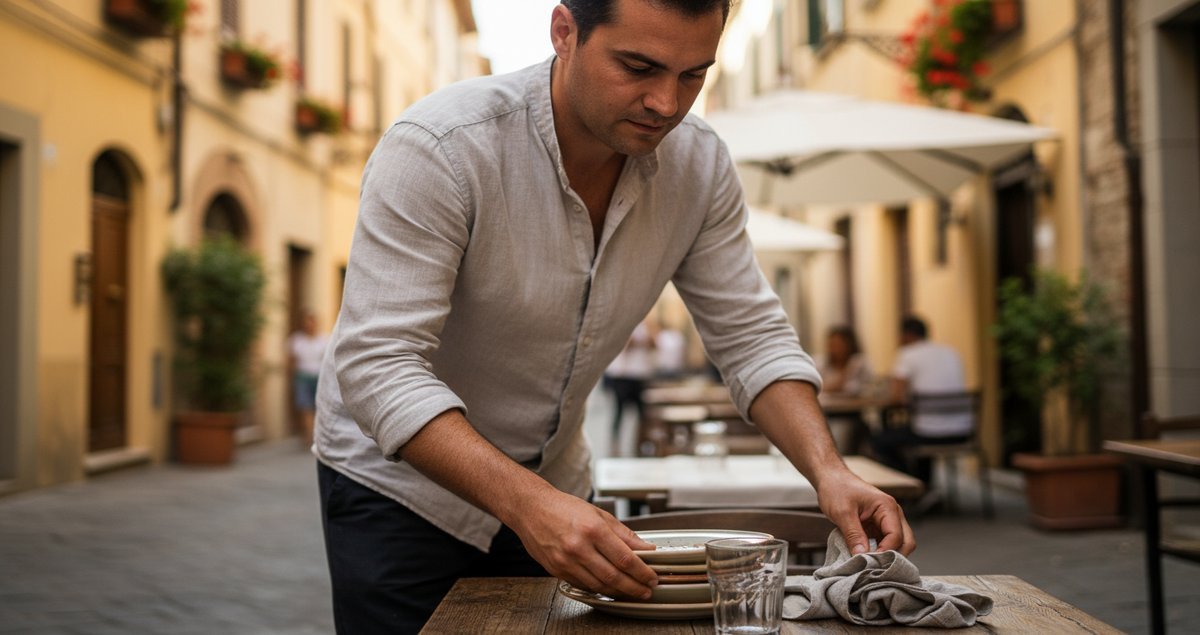
I started noticing the gesture years ago. It is small and quick and somehow insistently human. You push plates together. You stack a saucer on a bowl. A server approaches and you have already done a little of their job. People call it manners. Psychology calls it a signal. I think it is both a gesture and a mirror.
Why that tiny motion catches so much of our attention
At first glance the act of helping waiters clear the table looks like a social lubricant. It smooths the final awkwardness of finishing a meal. But the motion carries freight. It is an easily observable, low cost prosocial act that gives other diners a quick read on your interior life. You cannot easily fake the mechanical intuitions that move your hands when a server walks by. Those hands betray habit. They betray training. They betray the shape of your moral reflexes.
Behavior beats words in messy human labs
Decades of social psychology show that small spontaneous acts reveal motives more reliably than scripted speech. When we watch people help waiters clear the table we are watching an ethical microgesture in real time. There are at least three psychological currents that converge here. One is empathy and the direct impulse to reduce another person’s effort. Another is internalized social rules that say service work should be acknowledged. A third is identity performance where helping becomes a way to signal belonging or virtue.
Empathy or image management Which is it?
This question resists tidy answers because human motives are layered. The same movement can be empathy in one person and social maintenance in another. Research on the empathy altruism debate gives us a useful anchor. C Daniel Batson a long standing scholar in this area wrote that empathic concern can produce action aimed at increasing another person’s welfare. That is a precise way to say what feels obvious at the table.
“The most plausible account is that empathic concern evolved as part of the parental instinct among higher mammals especially humans If mammalian parents were not interested in the welfare of their very vulnerable progeny these species would quickly die out.”
Batson is not talking about etiquette. He is pointing to a mechanism. When someone helps a server they are often enacting concern that is triggered by seeing another person with an obvious workload. But this is not always pure. Some people help to craft an image. Others do it because of habit. The interesting part is that outsiders rarely can tell which motive is primary. The hand movement obscures the mind.
How context flips the meaning
Context matters. In a neighborhood trattoria where the staff know regulars by name the gesture reads differently than at a tourist filled bistro where tipping norms are murky. Power dynamics also change interpretation. When a manager packs plates for a junior server it looks like solidarity. When a customer volunteers the same motion it can either feel like gratitude or condescension. Good intentions do not immunize an action from being misread.
The curiosity of refusal
Sometimes servers decline the help. They do this for practical reasons or because of restaurant policy. The refusal can sting for the helper. That little rejection is instructive. It shows us that prosocial acts are not unilateral. They are negotiated. This negotiation reveals a cultural friction around respect and labor. Helping is not always a gift. It can be an intrusion.
Why some people never help even when they could
There are people who will never move a plate. That absence is instructive in its own way. It may signal strict role separation an aversion to appearing needy or an emotional numbness. There is also the habit of deferring entirely to paid labor which in many cases respects bodily boundaries and the dignity of work. I do not romanticize either position but I do notice that the act or its absence tells a story about how someone relates to public life and visible labor.
When help becomes a performance
Some diners use the gesture as social currency. They assemble plates with a kind of choreography. The motion becomes declarative. In workplaces or public dinners this can be strategic. You may want to be seen as collaborator rather than consumer. People who habitually stage these small acts often do so because those acts yield reputational returns. There is nothing inherently wrong with that. It is a complicated moral economy.
What restaurants actually want you to do
One hard truth is that servers rarely expect help and sometimes prefer you not to. Efficient service often depends on predictable workflows where an unexpected stack of dishes can complicate orders or sanitation. Yet many servers appreciate the gesture when it is respectful and unobtrusive. There is an etiquette within the spontaneity: make eye contact offer the pile and if declined that is the end of it. No explanations. No lecturing. Just an acknowledgement that you tried to lighten a small burden.
A small experiment you can try
Next time you clear plates notice your internal narration. Are you doing it because of impatience because you want approval because you genuinely worry about a server’s load or because you cannot stand clutter? Observe without judgement. See which motive sits heaviest. It is a tiny self study and it works better than giving yourself a moral lecture about being kind.
My uneasy conclusion and a tentative call
I do not believe helping waiters clear the table is a moral litmus test. It is however a diagnostic mirror. It reveals habits of attention or avoidance. It reveals how a person occupies shared space. I will say plainly that I prefer people who notice the invisible work around them and act with modesty. But my preference includes people who decline to help when that help would complicate someone else’s job. The messy human truth is that both attentiveness and restraint can be forms of care.
Summary table
| Gesture | Primary psychological signal | Possible misreads |
|---|---|---|
| Stacking plates | Empathy and prosocial habit | Image management or anxiety driven behavior |
| Leaving everything for server | Respect for role boundaries or emotional distance | Indifference or class based separation |
| Offering help and accepting refusal | Attentive generosity and respect for workflow | Potential embarrassment if refusal is misinterpreted |
FAQ
Does helping a waiter mean Im a good person
No single act determines moral worth. Helping a waiter is one visible behavior among many. It may indicate empathy but context and motive matter. Someone can perform this action for mixed reasons and still be broadly decent. The most honest conclusion is that the gesture is suggestive not definitive.
Should I always offer to help
Not always. Offer briefly and be prepared to accept a polite refusal. If a server seems rushed or the restaurant has a busy flow it may be better to thank them and leave the task to staff. Learn to read microclues and prioritize the server’s indications over your own discomfort with clutter.
Can offering help offend a server
Yes sometimes. If the offer is framed as instruction or if it upends the server’s routine it can feel patronizing. A modest offer framed as a question and followed by a quick apology if declined will usually avoid offense. It is about tone more than the plate itself.
What if I help because I want people to notice me
That motive is common and understandable. Public acts generate social returns. Awareness of that motive does not negate the practical benefit to the server. Still if self image is your primary engine try to balance recognition seeking with moments of anonymous help where you expect no applause.
Does culture change the interpretation
Absolutely. Different cultures have different norms about service interactions hierarchy and communal responsibility. In some places stepping in is expected in others it is intrusive. Learning local cues will sharpen your social accuracy and prevent accidental affronts.
In the end the table is a small theater where our ordinary ethics play out. The hands tell a story. If you listen you will hear more than you expected.
