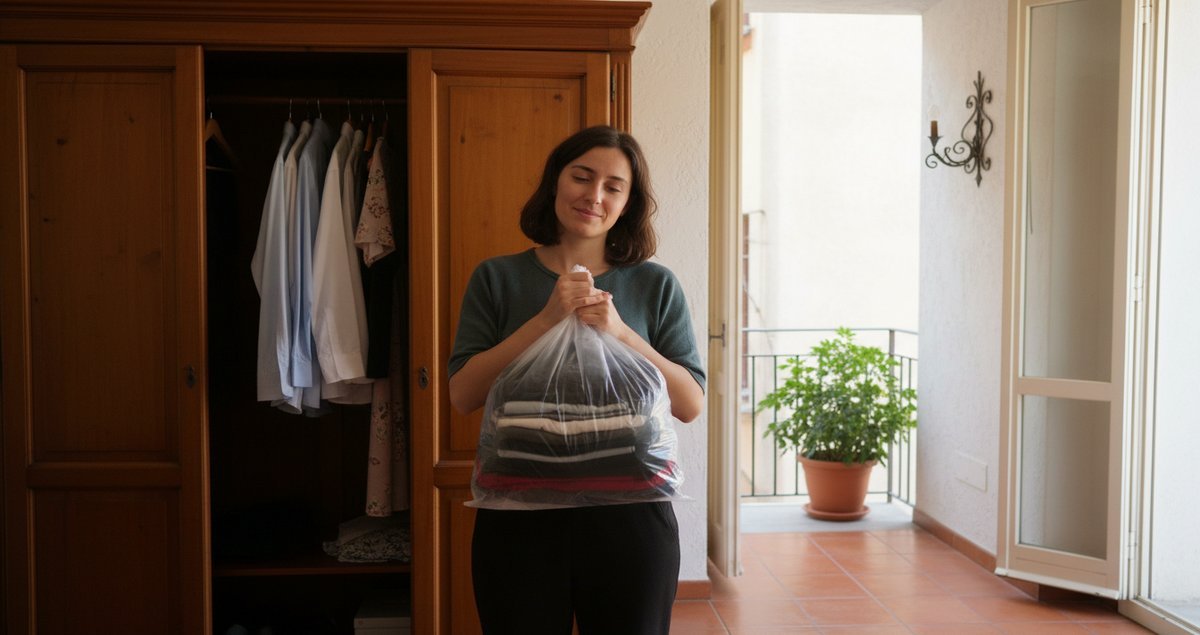
There is a small, stubborn truth in my life that no minimalist manifesto could have prepared me for. The morning when I stopped seeing all options and started seeing only what mattered was the morning I gave away three large bags of unworn shirts. That handover felt less theatrical than expected. It was quiet. No thunderbolt. Yet dressing became faster and, oddly, less political.
Why closets throttle mornings
Before we leap into tidy rituals or moralizing about charity, consider this: a crowded closet does not merely hide clothes. It hides intent. The minute the brain faces a crowded visual field it begins to triage. You stand at the threshold of your wardrobe and your brain runs a short, expensive audit. It compares patterns, recalls last week to avoid repetition, estimates weather and meeting tone, and simulates comfort. These are tiny computations but they stack. They feel like a drag on willpower and sometimes they win. That is why one less blouse matters.
Not about willpower but bandwidth
This is not a pep talk about being disciplined. It’s an observation: our cognitive bandwidth is finite and precious. The difference between an overstuffed closet and a curated one is not aesthetics alone. It is fewer on the table for your mind to weigh. With fewer decisions to make, the speed of choosing rises and the quality tends to as well. If this reads like economic logic applied to clothing, fine. It works.
Donating as a cognitive intervention
Throwing out or donating clothes is often framed as a cleanup graft. I prefer thinking of it as a cognitive intervention. You alter the environment so the brain must expend less energy computing trivial permutations. There is now a front-line study space where outfits suggest themselves instead of demanding consideration. The act of donation is not merely charitable for others. It is reparative for you.
“Our brains are not designed to handle the deluge of information that modern life throws at us.” Daniel J. Levitin PhD neuroscientist Professor Emeritus McGill University.
Levitin points to overload as a root cause. When your closet screams in textures and labels, your prefrontal cortex takes a hit. My experience agrees. After donating a batch of impulse buys I had kept out of guilt the wardrobe stopped being a battlefield of shoulds. It became a tool.
Donating reframes value
There is a trick to donating that is overlooked. If you decide to purge privately you risk replacing one pile with another. But donating makes a transverse cognitive shift: an item moves from potential inertia inside your home to active use elsewhere. That shift changes how you perceive what to keep. It’s not loss. It is redistribution. That reframing helps you let go without constructing stories of deprivation.
The practical speed gains
People want numbers. Fine. I will be intentionally imprecise because households differ. But here’s a credible pattern I have seen in repeated wardrobe cleans: First, visual search time drops. Hours of wasted rummaging vanish. Second, matching time shortens because fewer irrelevant options are present. Third, maintenance time falls since fewer items mean less laundering cycles and easier folding. Small savings across many mornings accumulate into hours and reduced friction over months.
“Mindfulness training helps to declutter the mental whiteboard so that working memory works better.” Amishi P Jha PhD Professor of Psychology Director of Contemplative Neuroscience University of Miami.
There is a surprising synergy here. Pair a donation purge with a brief morning ritual that reduces mental noise and the effect multiplies. The donated clothes remove visual clutter while a short pause disciplines attention. I am not prescribing a health regimen. I am reporting that pairing environmental change with simple attentional practice made my six minute routine reliably four minutes. More importantly, the decision satisfaction rose.
Fashion shame and identity friction
Be warned. Donating is messy in identity terms. Clothing holds outraged and tender stories about who we were or wanted to be. I gave away a jacket I once considered central to my teenage persona and felt a dull regret that lasted a day. Then I noticed I stopped reaching for it in imagined situations that never occurred. The removal helped me reconcile an old identity with my present one. The process can sting, but when it ends the closet stops arguing with you.
How donating forces better habits
Here is an unpopular claim. Giving away unused clothes is not merely altruistic hygiene. It trains a muscle: discernment. Once you regularly relinquish garments that sit unused you sharpen a judgment about what fits your life rather than your aspiration. This habit bleeds into purchases. People who donate more often buy less impulsively. They stop romanticizing hypothetical events and start asking what they genuinely wear in a normal week.
Not a sell on minimalism
I am not arguing for emptiness. The point is not to count items like a monk counts beads. The point is to build a wardrobe that accelerates mornings and reduces narrative friction. If you love bold outfits and your life asks for them, keep them. The magic is making those choices consciously rather than by default.
Anecdotes that matter more than rules
One reader wrote to me after a recent column. She donated two dinner dresses that had not been worn in ten years. She reported that mornings improved and that she felt guilty at first but liberated after. Another acquaintance swapped the phrase I might need it for the once I wore it. The language shift alone was revealing. The loss aversion eased when supply became purposeful rather than sentimental.
Small rituals to amplify the effect
If you want to try this without theatrics pick a weekday and commit to removing three items you have not worn in a year. Take them to donation that day. Do not store them in a give away bag for later. The immediacy changes how your brain resolves the decision. You may be surprised by how much lighter your mornings become within a week.
Open questions that keep this interesting
What happens when the rest of the household does not cooperate. Is it still worth the effort if you live with someone who accumulates? My tentative view: yes. Tangible change in one person alters the microclimate. The visual contrast encourages conversation. It is not guaranteed but worth testing.
Also, how long does the speed effect last? My informal observation is that gains persist so long as purchases are deliberate. Without that discipline clothing inflates again. So donation is part purge and part training.
Conclusion
Donating unused clothes is not purity theatre. It is an ergonomic fix for mornings. The act economizes attention. It simplifies choice architecture. It reframes value. And for many of us who treat the closet like a decision tax, it returns small but meaningful time dividends. I keep a modest capsule of statement pieces that make me feel certain and a larger bank of everyday garments that do not demand consideration. The result is not a perfect aesthetic. It is a calmer start to the day and, yes, faster dressing.
| Idea | Why it matters | Quick result |
|---|---|---|
| Donate unused clothes | Reduces visual and decision clutter | Shorter morning choices |
| Pair with short attention ritual | Declutters mental whiteboard | Improved working memory for decisions |
| Immediate donation action | Prevents indefinite postponement | Faster habit formation |
| Conscious buying | Prevents recluttering | Long term speed retention |
FAQ
How many items should I donate to notice a difference?
There is no fixed number. For many people three to five items is the lowest effective dose. The goal is to change the distribution of options so uncommon choices stop competing with common ones. If you live with a very large wardrobe you may need a larger initial pruning. The psychological effect happens when you experience fewer competing visual stimuli each morning.
Will donating affect my style or identity?
Possibly. Clothing ties into stories about ourselves. When you remove items you will feel shifts. Those shifts are not permanent erasures. Rather they expose what you actually wear and value. This can be uncomfortable at first but it often clarifies personal style rather than erasing it.
Can I donate expensive items I never wore?
Yes. Donating unused high value clothes often feels harder but it tends to yield the largest cognitive return. One expensive unworn jacket takes up the same decision space as ten inexpensive tees. The return on letting it go is disproportionately large.
What if I feel guilty about giving away perfectly good clothes?
Guilt is a normal reaction. Reframe the narrative: donation moves an item into active use rather than quieting it in your home. The recipient may get more value from it than the garment would ever get from your closet. That reframing often relieves guilt and makes letting go more humane.
How do I keep the gains from relapsing into clutter?
Make donations a recurring practice. Inspect your closet quarterly and remove items you have not worn. Also create a buying rule that forces deliberation. When purchases are less impulsive the gains from donating stick longer.
That is the compact truth. Clean closet clear mind is not a slogan. It is a practice of pruning that buys you mornings back.
