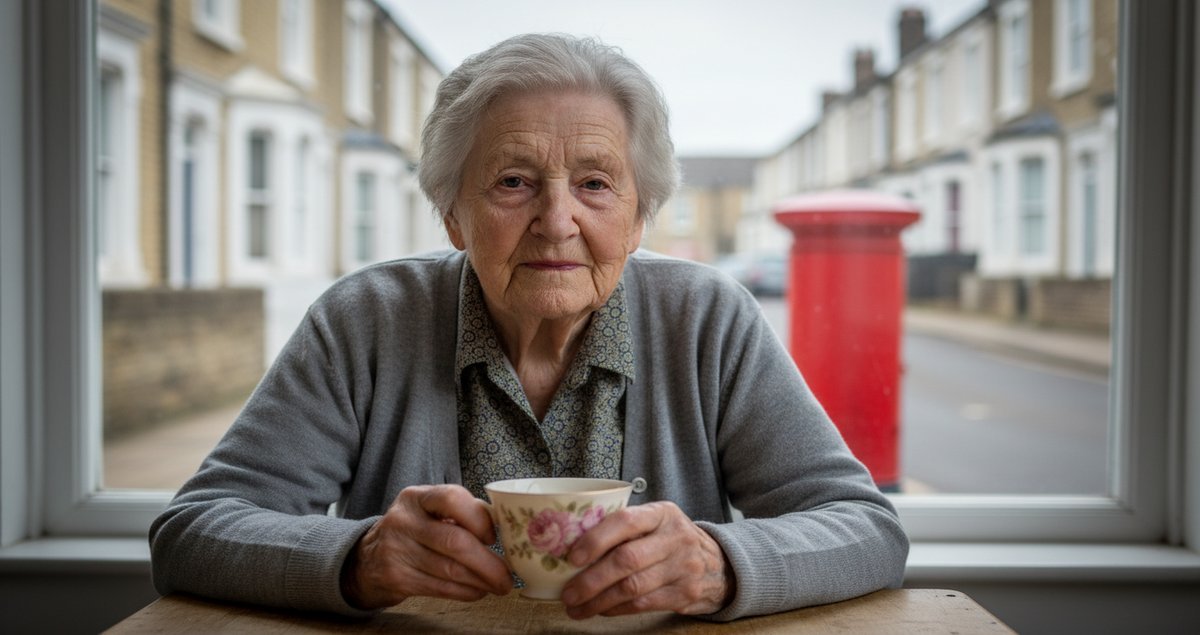
She lives in a narrow flat above a British high street. The curtains are thin and let the grey light in. Her kettle is never switched off in winter and a single teacup sits on the table with a ring of years around its base. At 104 she lives alone and her life is neither quaint nor tragic. It is, simply, stubbornly practised.
The habit that keeps appearing in every conversation
People want a single recipe when they hear about someone who reaches a century and carries on living alone. Diet. DNA. Sudoku. They ask for the obvious list and then are disappointed when the answer is more mundane and more specific. The one thing that keeps returning in interviews and in passing observations is not a pill or a regime. It is a repeated small motion. Every morning she opens her front door and steps outside for a short walk and a breath of air.
It is not the heroic walk of fitness influencers. It is a short slow route down to the grocer and back. Sometimes she pauses to look at the birds. Sometimes she buys a newspaper. Sometimes she leans on the rail and watches a child pass. The motion of leaving the flat and returning to it has a boundary making the day visible. That boundary is a habit and the habit structures a life.
Why a tiny ritual matters more than a grand plan
There is a difference between an action that is practised and an action that is performed. Practised actions are repeated, imperfect, adaptive. She has learned to navigate uneven paving stones and to step over a low kerb that looks higher in the rain. She has learned which shop assistant will cross the room to bring the box of teabags to the till and which will pretend not to see her. These are not triumphs. They are negotiations with a city that is simultaneously familiar and subtly alienating.
Many of us assume that living alone at 104 must be a life built from stubborn denial. I do not think that. There is resignation in late life certainly. There is also a quiet engineering of days. Leaving the flat every morning makes the calendar meaningful. Habit creates small stakes and those small stakes keep you connected to time. Habit is less glamorous than philosophy but more durable.
Loneliness is not a single thing
We talk about loneliness as if it were a single fault in character that can be plugged with a family visit or a smartphone app. But being alone and being lonely are not the same. She knows this. She has friends who visit and neighbours who collect packages but she also deliberately chooses solitude. She reads mail aloud to herself at the table. She writes notes that will never be posted. There is company there in the motion of her voice and the act of folding a letter.
Focusing on the present and experiencing the here and now becomes more important to older adults.
Laura Carstensen PhD Founding Director Stanford Center on Longevity.
That observation from Laura Carstensen explains a corner of this life. The morning walk is a way to arrive in the present. It is a device for attention. It is a deliberate refusal of drift. You could call it survival by small rituals. I prefer to call it the art of returning.
Community in fragments
Her social world is made of fragments. A cleaner who comes once a week. The baker who remembers her order. A retired teacher who plays Scrabble by telephone. These fragments do not sum into a typical suburban social life. They create instead what I would call an aligned patchwork. Each small contact is a line in a network that is not visible on a map but is entirely real for someone living on a single wage of time.
There is power in those small obligations. They force reciprocity. Someone brings her milk and in return she passes on a jar of jam or a piece of gossip. The transactions are low in monetary value and high in narrative value. They say you are part of a town and not simply a body to be housed.
Where the neat narratives fail us
We like tidy stories because they make us feel we can manage what happens next. The neat narrative is that social policy or a clever product will fix the problem of solitary ageing. That is seductive and also false. Her life at 104 resists neat policy solutions because it is built from a dozen small adaptations not from an institution. It is not scalable in the usual sense. You cannot simply replicate the precise arrangement of personal histories and small friendships that made her independence possible.
That said there are things that help. A reliable bus service reduces risk. A shop that has the same staff over a decade provides stability. People living alone are quietly dependent on structures that rarely make headlines. The public world either scaffolds or it does not. That scaffolding is ordinary infrastructure not charity. It is the thing planners do badly when they focus only on metrics and forget what a human day looks like.
My bias is towards agency
I do not romanticise this kind of independence. It is precarious for many. But I am suspicious of pity. To pity is to take from a person the capacity to arrange their life. To admire from afar is safe. My view is that we should offer practical help without extinguishing the small rituals people rely on. Let them take the walk. Let them tell the same joke three times and then laugh at it again. Those repetitions are not boring. They are tools for coherence.
What we miss when we only measure deficits
Researchers often count deficits. Falls. Hospital visits. Food insecurity. These are important metrics. But they do not measure rhythm. They do not measure the difference between a day that begins with the sound of a kettle and a day that begins with waiting for a call. We need more nuanced ways to understand elder life than a list of catastrophes. A hundred small returns are hard to quantify but they matter. Habit is a kind of invisible health that official forms rarely record.
She may at times be stubborn about help. She may refuse a meal service because it would interfere with the ritual of her shopping. That refusal is inconvenient. It is also an assertion of taste and continuity. We should respect that even while ensuring safety nets exist for the day the ritual itself becomes impossible.
Closing thoughts that do not finish the story
She does not have a philosophy of longevity published in twelve languages. She has an approach. It is composed of repetition and small risks. It is composed of morning doors opened and evening curtains drawn. That is not an answer or a magic formula. It is simply the way one person has kept her life recognisable across a century.
The next time someone tells you they want to age at home insist they answer a simple question. What will you do each morning to make the day begin. The answer will not always be dramatic. Often it will be a walk to the shop or a cup of tea by a window. Those gestures are the quiet architecture of a life.
Summary Table
| Theme | What it Means |
|---|---|
| Daily ritual | Creates boundaries and anchors the day |
| Solitude versus loneliness | Alone can be chosen and sustained by small social fragments |
| Local infrastructure | Ordinary services enable independent living in practical ways |
| Measurement blind spots | Rhythm and habit are rarely captured in formal metrics |
| Respecting agency | Support should preserve personal routines while offering safety nets |
FAQ
How common is it for people over 100 to live alone in Britain
It is relatively rare but not unheard of. The number of people who reach one hundred has grown in recent decades and among them a minority continue to live independently. Patterns vary across regions and depend on family structures and access to local services. The headline statistic hides a range of lived experiences from highly networked independence to solitary precariousness.
Is there one habit that guarantees long life
No single habit guarantees long life. Longevity is an accumulation of many factors including genetics social conditions and chance. What we can say is that small habitual patterns give life structure. Those structures help people maintain routines and social ties which in turn make day to day life more manageable. Habit is not a promise. It is a practical tool.
How do communities help people who choose to live alone
Communities help in invisible ways. Longstanding shop staff reliable public transport and local volunteer networks create a scaffolding that supports independence. Emotional help is delivered through repeated small interactions rather than grand interventions. A community that remembers a name or a preference is performing a kind of social care that formal services often overlook.
When does independence become risky rather than admirable
Independence becomes risky when the rituals that sustain a life are broken and there is no safety net to catch the fall. Signs include repeated missed meals declining mobility and social withdrawal. The tricky part is that these signs are gradual. They erode the daily architecture slowly. That is why respectful conversation and timely practical help matter more than dramatic interventions.
Can a short daily habit really change how someone feels about living alone
Yes habits can reframe experience. A small ritual gives a person reasons to get out of bed to arrange the day and to notice the world. Those reasons accumulate into a lived sense of purpose that is not the same as formal employment or family responsibility. Rituals change the texture of days rather than their length.
