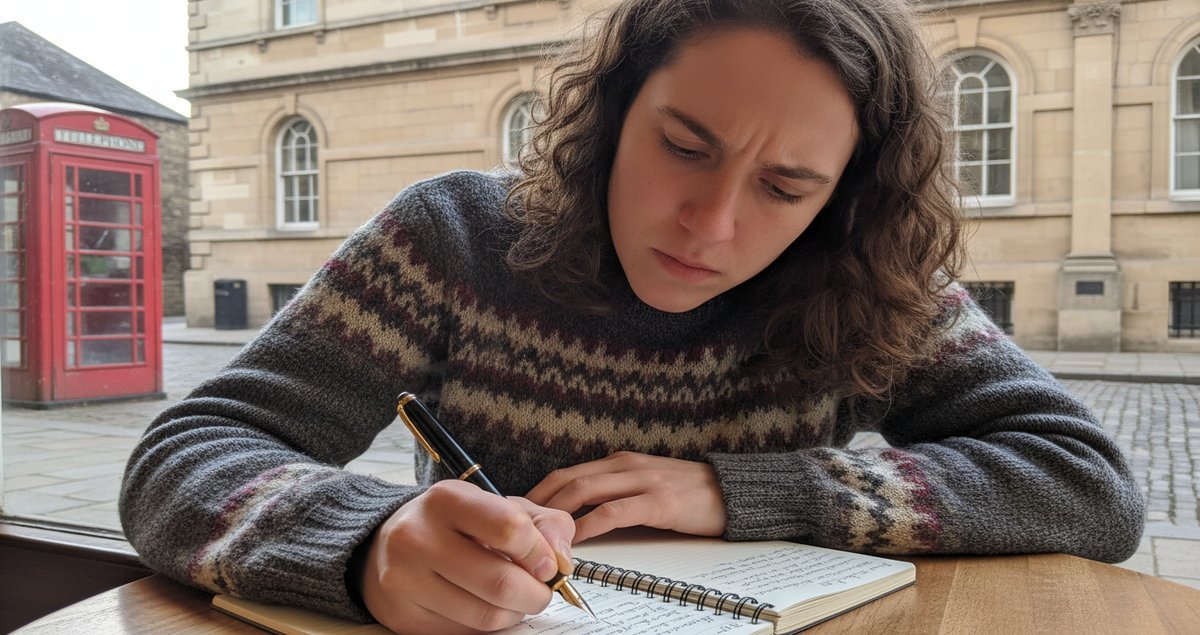
There is an odd calm that arrives when a pen meets paper. It is not the calm of convenience or speed. It is a rougher, grainy sort of clarity that will not be coaxed out by a keyboard shortcut. In a world that praises fast output the false bargain is to confuse volume with thoughtfulness. Writing by hand forces a different economy of attention and that economy matters for how we sort our feelings.
Slower motion and the architecture of thought
Typing rewards speed. Typing rewards capture. But clarity is rarely the fastest route. When you write by hand you are committing to a tempo that imposes selection. The letters take time, the hand insists on choices. That lag between thought and form creates what I call a pause for interior negotiation. We are asked to decide which words deserve ink. That judgment is itself a kind of emotional work, one which often refracts what we feel into forms we can examine. Typing, impatient and greedy, often sidelines that work.
Why the delay matters
Delay is not procrastination. It is friction that invites revision in the mind before revision on the page. The motor acts of forming a letter, of dragging a line, of pressing a nib into paper register bodily traces of thought. Those traces are not decorative. They are cognitive hooks. They let the brain rerun an idea through touch as well as sight, producing a layered impression. This layered impression is what turns nebulous feeling into language you can hold.
Research that matches the gut feeling
Researchers have noticed patterns that echo what many of us sense. In experiments where participants learn or take notes handwriting tends to produce deeper processing than typing. The classic finding is not that handwriting produces perfect memories but that it tends to nudge people toward synthesis rather than transcription. That matters when the task is to make sense of confusion rather than to archive it.
When people type their notes they have this tendency to try to take verbatim notes and write down as much of the lecture as they can. The students who were taking longhand notes in our studies were forced to be more selective because you cannot write as fast as you can type. And that extra processing of the material that they were doing benefited them. Pam A. Mueller Psychology graduate student Princeton University.
That quote is not a cure all. It is evidence that the simple mechanics of handwriting bias the mind toward processing rather than mere capture. But there is more. Neurophysiological work suggests that when we form letters by hand we engage sensorimotor circuits that typing does not recruit in the same way. Those circuits glue movement to meaning. In emotional work that glue can stop an idea from simply evaporating.
Our bodies are designed to interact with the world which surrounds us. When writing by hand the movements involved leave a motor memory in the sensorimotor part of the brain which helps us recognise letters. This implies a connection between reading and writing and suggests that the sensorimotor system plays a role in the process of visual recognition during reading. Anne Mangen Associate professor The Reading Centre University of Stavanger.
Writing by hand as an emotional instrument
Call it crude. Call it old fashioned. But a lined notebook will often reveal what the screen conceals. I keep a battered ringed notebook for moods that resist being named on social media. The act of drawing a small jagged underline under a sentence creates a seriousness that a highlighted block of text never does. You cannot highlight regret into clarity. You can only write it until you feel its edges.
There is a particular honesty to handwriting. Sloppy flourishes and cramped letters are evidence of a mind at work. Typed text tends to flatten those microvariations. On a keyboard every sentence is uniform. That uniformity is convenient for scanning but poor at signalling nuance. Handwriting preserves the awkward parts where meaning hesitates. Those awkward parts are where insight often hides.
The ritual advantage
Ritual matters. It is not mystical to say that lighting a candle or choosing a particular pen can cue attention. Ritual shapes expectation and expectation shapes focus. When I choose to write with a fountain pen I am announcing to myself that I expect to take the time. That alone biases the work toward patience. The ritual need not be elaborate. It might be the simple decision to close the laptop lid. That choice sometimes creates the same margin of quiet necessary for clearer feeling.
Not all handwriting is equal
There is handwriting that obfuscates just as there is typing that clarifies. A scrawl of adjectives without structure will not help. The advantage lies in the interplay of slowness and purpose. When you write by hand with the aim of sorting rather than reporting you get different outcomes. That is why the form of the exercise matters. Journaling prompts that demand naming a mood or tracing a memory will succeed more than freewheeling transcription because they force specific acts of selection.
A practical stubbornness
I suggest resistance to the seductive convenience of the keyboard for tasks that require emotional clarity. Use the laptop for logistics. Use a pen for internal weather reports. It is a stubborn distinction and one I defend not as nostalgia but as a method. There will be moments when typing is absolutely the right tool. There will also be times when typing is the easy excuse for not doing the harder inward work.
What modern tools get wrong
Modern devices promise frictionless production. That promise is seductive because production often feels like accomplishment. But not all accomplishment is understanding. Typing can create an illusion of having processed feelings because the product looks polished. The keyboard is too eager to tidy. That tidiness often comes at the cost of the messy, crooked moments where we actually come to understand ourselves.
There is also the problem of external storage. A file can be saved and forgotten. A notebook resists being ignored. It sits, tangible, with the residue of decisions. You cannot quick search away the smudge of an ink blot. That smudge anchors memory differently than a timestamp.
Leaving room for mystery
I do not claim that handwriting supplies answers. Often it amplifies questions. It helps us feel what we feel more accurately and that sometimes leads to discomfort. But clarity is not always comfortable. It is, however, more useful than the numbness of perfectly typed detachment. Some passages of experience should remain unresolved on first writing. Those loose ends are productive. They become threads you can follow later. Typing often tempts us to tidy into an artificially resolved narrative too soon.
Summary table
| Feature | Handwriting | Typing |
|---|---|---|
| Pace | Slower, invites selection and synthesis. | Faster, encourages verbatim capture. |
| Sensorimotor engagement | High engages motor memory and tactile feedback. | Lower minimal haptic feedback. |
| Emotional nuance | Preserves hesitation and microvariations. | Levels emotional texture into uniform text. |
| Ritual and focus | Supports ritual that cues attention. | Optimised for multitasking and output. |
| External storage | Physical presence resists neglect. | Easy to archive and forget. |
FAQ
Does handwriting actually change how I feel about something?
Often it does. The act of forming letters slows you down and invites interpretation. That extra step between feeling and text creates an opportunity to name and refine sensation. Naming a feeling is not always the same as resolving it but it often reduces its opacity which in itself can feel like relief.
Can I get the same clarity using a stylus and tablet?
Possibly. Some digital pens mimic the motor feedback of ink and can capture the temporal rhythm of handwriting. The key element is the embodied movement and the need to form characters by hand. If a stylus preserves that motor pattern and you use it without automatic transcription into editable typed text then it can reproduce many of handwriting’s advantages.
How should I structure handwriting practice to improve emotional clarity?
Begin with directed prompts rather than freewheeling lists. Ask yourself what you felt most strongly today and why. Describe that feeling in concrete physical images rather than abstractions. Resist the urge to edit immediately. Allow a messy first pass. Come back later and try to summarize the paragraph into a sentence. The compression exercise often reveals the underlying pattern.
Won’t handwriting slow me down if I need to work quickly?
Yes it will. That slowness is the point when your aim is clarity rather than output. Use handwriting selectively for tasks that need sorting. Keep the keyboard for tasks that demand speed and record keeping. The skill is in choosing the right tool for the inner task at hand.
Is there evidence that handwriting helps learning beyond feelings?
Studies show advantages for conceptual learning when notes are taken by hand. Those results suggest handwriting aids certain kinds of cognitive processing that are relevant both for memory and for making sense of complex material. The mechanisms appear related to deeper encoding produced by selection and synthesis during the slower act of handwriting.
There will be no miraculous conversion. But if you are trying to sharpen what you feel into something you can actually address, take a pen. The mess that follows is often the start of something clearer.
