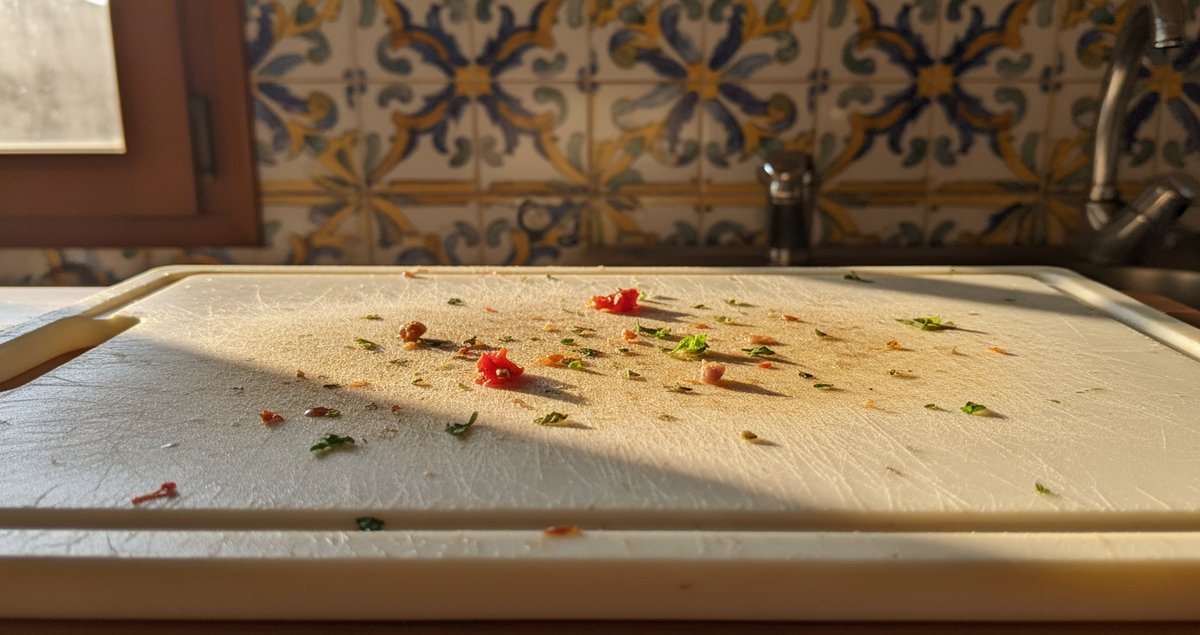
There is a quiet, stubborn thing happening in most kitchens that looks harmless but is busy rewriting the story of our salads and supper plates. Knife grooves in your cutting board collect more than crumbs. They trap moisture and microbes in a way that ordinary washing often fails to fix. I am not asking you to panic. I am asking you to notice the small things you ignore when you are tired at the end of the day.
Not an urban myth but not a scolding either
The advice to use separate cutting boards for raw meat and vegetables has been around for a while. It sits on USDA and food safety pages, and people repeat it like a culinary superstition. But the reason it persists goes deeper than habit and more than simple sanitation theater. Knife strokes carve microscopic valleys into plastic and wood. These valleys are efficient little shelters. They hold juices oils and tiny bits of food. They keep moisture. And where there is moisture bacteria find a home.
What the grooves do that a wipe cannot
Washing a board is a mechanical act. You scrub you rinse you may even run it through the dishwasher. But the grooves are three dimensional and unpredictable. Surface cleaners reach the top and the sides but cannot always get into the narrowest parts of a cut. If your washing routine relies on a quick rinse or a wipe with a kitchen towel the grooves stay moist and inoculated. Over time they accumulate a mixed community of microbes and organic residue. The result is a persistent reservoir that can cross over from one food to another.
Experts say separate boards are not overcautious
The pragmatic voice on this is Ben Chapman. He is an associate professor and a food safety extension specialist at North Carolina State University and he has been studying cutting boards and cross contamination for years. Ben Chapman points out that different materials and different cutting habits change the risk profile but not the wisdom behind separation.
Wood plastic and stone cutting boards all have their advantages and their drawbacks. Hard woods like maple are fine grained and can pull fluids into the grain which helps dry out the surface while plastic can be sanitized in a dishwasher but will scar and form grooves where bacteria can hide. Ben Chapman associate professor and food safety extension specialist North Carolina State University.
This quotation is not an appeal to authority. It is a reality check. Different boards behave differently. Some materials resist deep gouging. Others are easy to sanitize in a machine. And those knife-made crevices are not just cosmetic. They are ecological niches.
Grooves are microhabitats
Think of a groove as a tiny canyon. It can shade cells from drying air and shelter them from heat. It can also collect organic molecules that feed microbes. Over repeated use these canyons become complex places where community interactions and biofilm formation occur. Biofilms are the microbial equivalent of neighborhoods. Bacteria embedded in biofilms are harder to rinse away than free floating cells. With each chop you nudge organisms from these niches into your food path.
I am opinionated about convenience and risk
I get it. Home cooks want one cutting board that does everything and a fast wash afterward. This is convenience capitalism playing out in kitchens. But when you weigh that convenience against the potential of cross contamination the math looks different. It’s not a moral failing to keep separate boards. It is a decision about which tiny risks you accept at dinner time. My preference is blunt. Keep a board for raw proteins and another for produce. Label them mentally or physically. The time savings of not switching is almost always smaller than the time and discomfort of dealing with a spoiled meal or foodborne upset.
When washing is not enough
There are moments when even proper washing is insufficient. Heavily scarred plastic boards with deep grooves should be replaced. Wooden boards that have large cuts or warping also need replacement. Some woods and finishes are better at resisting deep scoring. Other materials like high density polyethylene may be easier to clean but will hold permanent grooves once they form. The bottom line is this. A board that shows persistent grooves is an index of accumulated risk. Replace it sooner than you want to.
A few practical nuances that most lists miss
One nuance is rhythm. How you chop affects how quickly grooves form. Heavy hard chopping on a small board concentrates force and creates deeper cuts than gentle slices on a larger surface. Another nuance is drying. Moisture lingers longer in cooler kitchens or when boards are stored upright crowded against a backsplash. A damp board gives microbes a window even if you washed with soap. Finally finish matters. Food grade oils or beeswax can change how moisture interacts with wood but they do not make a wounded board whole again.
Design choices and kitchen culture
There is also a cultural element. Pro kitchens adopt systems. Color coded boards are not just for looks. They are tactical. Home kitchens can be less regimented and still safe if people accept small rules. For example never put raw meat on a board then reuse it for salad without cleaning and drying. Period. But beyond that rule select boards that match tasks. Use a forgiving wood or composite for produce and a rugged washable plastic for meat. This is not dogma. It is a pragmatic division of labor that reduces moments of carelessness.
Open ending observation
I will not pretend this is tidy. Science around materials microbes and domestic behavior evolves. Researchers continue to study how different wood species finishes and plastics host microbial communities. There is no single perfect board. But the pattern is clear. Knife grooves create persistent microenvironments that ordinary quick washes do not reliably undo. Separate cutting boards are a modest change with outsized returns in reducing cross contamination opportunities.
Summary Table
| Issue | What it means | Action |
|---|---|---|
| Knife grooves | Crevices that trap moisture and organic residue | Monitor for deep cuts replace when excessive |
| Material differences | Wood may draw moisture into grain plastic scars | Choose wood for produce plastic for raw meat or vice versa according to cleaning habits |
| Cleaning limits | Surface washing misses deep niches | Sanitize when possible let boards dry fully consider dishwasher for plastic |
| Kitchen practice | Cross contamination occurs through reuse and poor drying | Maintain at least two boards and a clear routine |
FAQ
Do knife grooves always harbor dangerous bacteria?
No they do not always harbor pathogens. Grooves create conditions that allow microbes to persist and sometimes form biofilms. Whether those communities contain pathogens depends on what touched the board in the first place and on environmental conditions. The practical takeaway is not to assume safety but to reduce opportunity by separating tasks and watching for wear.
Can I restore a scarred cutting board?
Minor scarring can be sanded out on wooden boards and the surface re oiled. Deep gouges are harder to rehabilitate. Food grade mineral oil or a beeswax mix can extend life and change moisture behavior but will not make irreparable grooves disappear. For plastic boards replacement is often simpler and cheaper than extensive repair.
Is color coding necessary or just a kitchen affectation?
Color coding is a useful cognitive shortcut. It reduces the small errors that come from tiredness or distraction. It is not strictly necessary but it is effective. A labeled system helps even in imperfect households and it reduces the friction of doing the right thing consistently.
Does sanitizing with bleach fix groove problems?
Sanitizing with a properly diluted chlorine solution can lower surface bacterial counts and help control contamination. However sanitizers have limited reach into the narrowest grooves and will not repair structural wear. Sanitizing is part of a hygiene toolkit but not a cure all for a board that is physically degraded.
How often should I replace my cutting boards?
Replacement depends on frequency of use and type of food processed. A heavily used plastic board used for raw meat may need replacement sooner once obvious grooves appear. A well cared for wooden board used for vegetables may last longer. Inspect boards regularly and replace when deep scars cracks or warping appear because these are signs that cleaning will become less effective.
