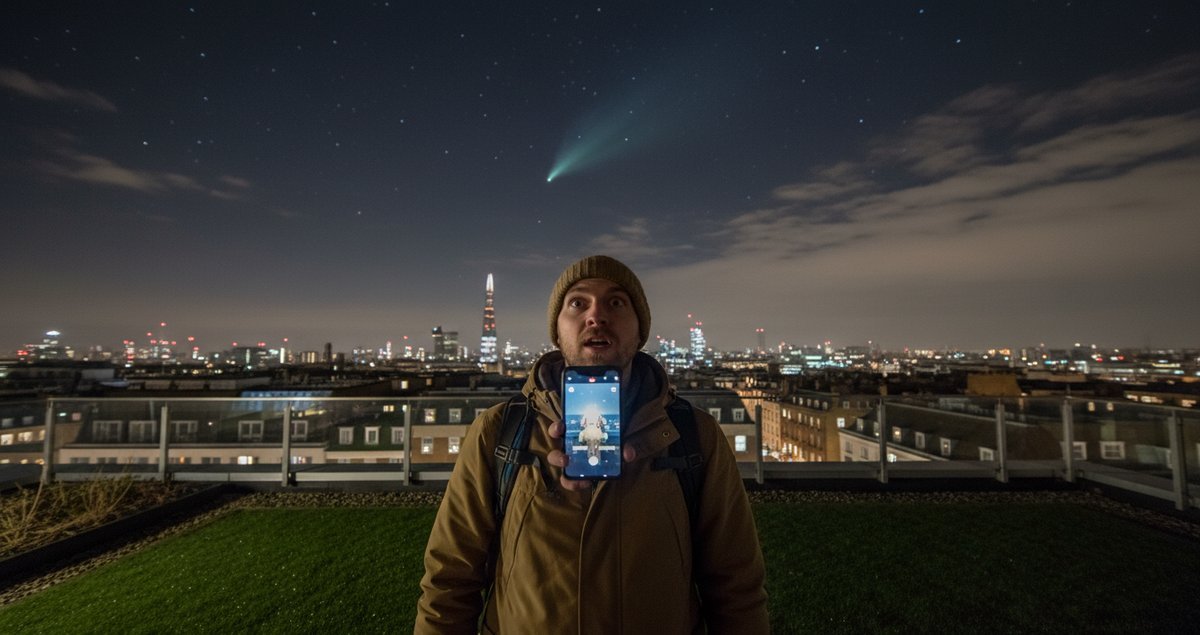
The sky gave up a secret. Not everything that slips through our solar system behaves like one of our own comets. Over the last months an international patchwork of instruments from ground based telescopes to Hubble and Webb have stitched together images of the interstellar visitor known as 3I ATLAS. The result is not merely prettier pictures. It is a small, noisy dossier about matter born around other stars and hurled into our neighbourhood. The images are compelling because they are varied and because different eyes saw different things.
Why these images matter more than a single snapshot
Photographs taken across multiple observatories do something that numbers on a chart cannot. They reveal texture. They show dust fans forming at odd angles, jets that flare unexpectedly, and the way sunlight scatters off grains that likely formed in an alien protoplanetary disk. A single telescope gives you resolution or spectrum or timeliness. The coalition of instruments gives you a narrative thread through behaviour and composition. That narrative matters because 3I ATLAS is only the third interstellar object confirmed to pass through our system. We are still learning how to read its handwriting.
What the cameras saw
Hubble delivered what most outlets are calling the clearest pictures yet. The comet can look like a teardrop shaped cocoon of dust around a compact nucleus in Hubble frames. Webb added the infrared perspective revealing gases and signatures of organic compounds that glow differently than rocky debris. Ground observatories filled the gaps in time and angle. That mix is why scientists claim not just an image but a small inventory of materials and behaviour.
No one knows where the comet came from. It’s like glimpsing a rifle bullet for a thousandth of a second. You can’t project that back with any accuracy to figure out where it started on its path. David Jewitt Astronomer University of California Los Angeles.
Jewitt is blunt and unromantic which is appropriate. The comet is ephemeral in our view and inscrutable by origin. Still the pictures let us quantify things we could not before. Hubble constrained the nucleus size more tightly. Webb and infrared instruments identified molecules. Radio telescopes measured dust dynamics. Each observatory added a stanza to a poem that refuses neat closure.
What surprised observers in the images
One surprise is timing. Instead of neatly following an expected brightening before perihelion and a fade afterwards many observatories recorded outbursts and brightness variations at times when simple models would have expected calm. Some instruments found molecules that typically evaporate nearer to a star than 3I ATLAS ever was while others logged delayed dust release. These are not contradictions so much as clues. They hint at an unusual internal structure or a composition layered in ways we rarely observe in solar system comets.
Another surprise is scale. Estimates of the nucleus varied early on. The combination of high resolution imaging and follow up observations knocked down the extreme upper estimates and gave a range that still leaves room for the object to be substantial enough to have an interesting history. In photos the coma and tail behave like they are being sculpted by a mix of volatile release and radiation pressure acting on surprising particle sizes.
On the challenge of catching a moving target
Pointed instruments have to hunt 3I ATLAS across the sky and all of them wrestle with timing. That is why the multi observatory approach is not a luxury. It is a requirement. Someone on the Webb team put it plainly.
It was quite challenging. Marco Micheli Astronomer Near Earth Object Coordination Centre European Space Agency.
He was describing logistics but his short sentence underlines a deeper truth. A moving interstellar target forces the astronomical community into improvisation and cooperation. Those improvisations produce images that are complementary rather than redundant.
A personal note on how images change the conversation
I do not want to be sentimental about pixels. Yet images change how scientists and the public talk about the same data. A spectrum might tell you that carbon compounds are present. A picture invites us to imagine the dust as a physical world shaped by processes we do not completely understand. That is good and dangerous. Good because it provokes hypotheses. Dangerous because human imagination wants to finish the story and sometimes it finishes it badly.
My gut says we are at the stage where caution and curiosity must be equally loud. The images tempt grand claims about where the comet came from. The correct move is to let images, spectra and dynamics argue in concert before we crown any origin story. Images push us toward narrative. Science should keep us tethered to measurement.
What the images imply about other planetary systems
The kinds of dust and molecules seen in the combined datasets create an immediate comparative exercise. How like or unlike are building blocks we see in other systems when compared to our own comets? Preliminary readings show both familiarity and novelty. Familiarity in the sense that water and carbon bearing compounds exist. Novelty because their relative abundances and the behaviour of dust grains differ. That could reflect a different chemical environment where 3I ATLAS was born or a long exposure to interstellar weather that altered its surface.
We should resist the impulse to make 3I ATLAS a universal template. It is one sample and samples in astronomy are expensive. Still it widens our aisle of possible origins. The images make the population of interstellar visitors feel less like a curiosity and more like a field worthy of routine study. That is an escalation in how we think of the cosmos.
Questions that remain despite the pictures
The images are beautiful and stubbornly incomplete. They do not answer where precisely the comet formed. They do not explain the delayed outbursts fully. They leave open the internal structure question. These gaps are not failures. They are invitations. Each observatory that photographed 3I ATLAS has given the next team a better attack plan.
And there is a policy question hidden behind aesthetics. The ability to marshal multiple observatories quickly depends on funding plans and cross agency goodwill. The images of 3I ATLAS are a product of infrastructure as much as instrumentation.
Summary table
| Aspect | What the images revealed |
|---|---|
| Structure | Teardrop shaped dust cocoon and active jets around a compact nucleus. |
| Composition | Water ice and carbon bearing molecules detected by infrared instruments. |
| Behaviour | Unexpected outbursts and delayed dust release not predicted by simple models. |
| Scale | Nucleus estimates narrowed by Hubble but still with significant range. |
| Scientific value | Cross instrument imaging provides complementary constraints on origin and evolution. |
Frequently asked questions
Is 3I ATLAS dangerous to Earth?
Short answer no. The images and orbital measurements both confirm that the comet’s path keeps it well outside any hazardous corridor for Earth. Observatories tracked its motion precisely and the timings used to capture the images rely on a well measured trajectory. The public can view the images and data without concern for impact risk.
Do the images prove the comet came from another star?
The images themselves are not the proof of origin. Origin is determined by trajectory and velocity measurements interpreted in a celestial mechanics framework. The imaging contributes by revealing physical properties that help compare this comet to solar system comets and thus provide circumstantial evidence about its history. The orbital data combined with imaging and spectroscopy give us a robust conclusion that this object is interstellar in origin.
Will more images answer all remaining questions?
More images are valuable but they are not a panacea. Different observational modes answer different questions. High cadence imaging helps with transient events. Spectroscopy constrains composition. Radar or in situ sampling would answer structure questions more directly. The images are a crucial piece of an ensemble approach but not a solitary key.
What do the images say about life beyond Earth?
The presence of organic molecules is interesting because these molecules are common ingredients in planetary chemistry. Images hint at where such compounds might be sequestered in small bodies that travel between systems. That said images and present measurements do not equate to evidence of biology. They inform models on chemical transport and diversity in planetary systems rather than directly implying life has been carried by this particular object.
Why did so many observatories participate?
Because interstellar visitors are fleeting and rare. No single facility can collect every useful type of data. Hubble gives resolution. Webb brings infrared composition. Ground arrays provide temporal coverage. Together they transform ephemeral discovery into multi dimensional science. The images are the public face of an urgent scientific choreography.
We are left with images that look like a dossier and feel like an invitation. We do not know the entire story of 3I ATLAS. We know enough to be insistent that these events matter and that the images should make us impatient for the next visitor. Astronomy often progresses in fragments. Right now the fragments are bright and interesting enough to keep us looking up.
