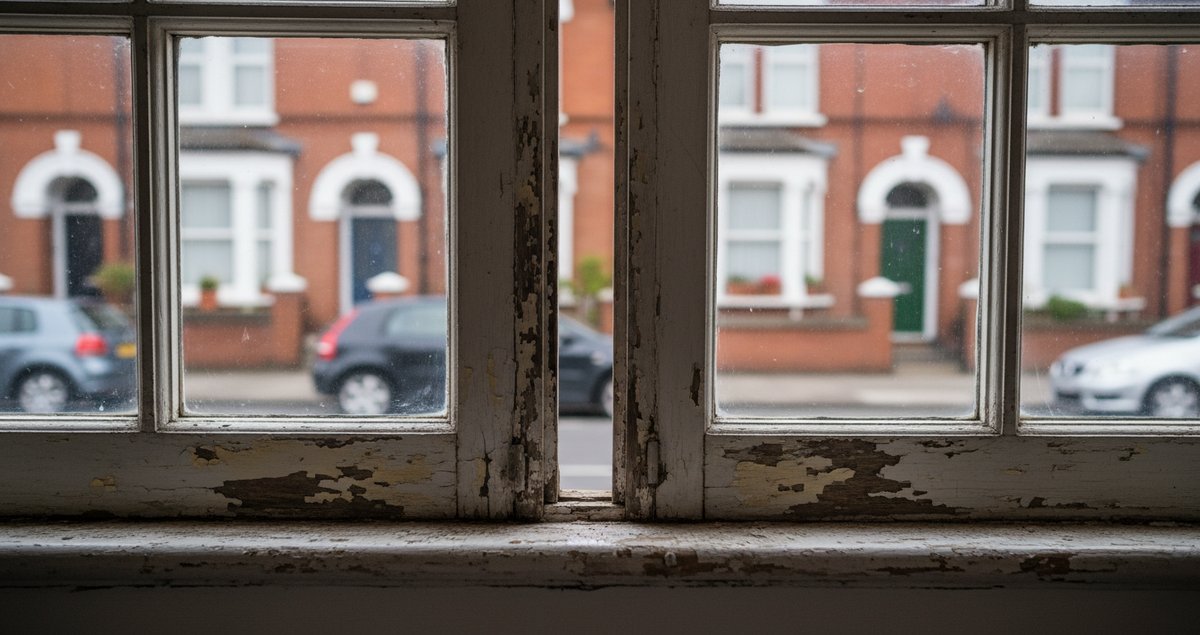
There is a stubborn idea floating about that older houses were simply badly built and that modern airtight construction is an unalloyed improvement. That story is tidy and sells well, but it misses something important. The leakiness of older homes was often a deliberate outcome of materials, heating methods and lived practice. It made these houses act differently from the hermetically sealed boxes we build today. This is not nostalgia for its own sake. It is an attempt to understand how buildings behaved in the round and why some of those behaviours mattered in ways we still do not fully control.
How homes leaked and why that mattered
Older homes leak because they were invented with different priorities. Solid masonry walls used porous lime mortars and renders. Sash windows sat in timber frames with gaps. Open hearths and coal fires required oxygen and encouraged a movement of air from ground level to chimney top. Those were not construction defects. They were functioning parts of the house. The air movement they produced carried moisture and stale air out of rooms at times when fresh air was otherwise hard to come by.
That movement also smoothed a kind of environmental roughness. Walls and floors made from hygroscopic materials buffered humidity. A damp kitchen did not immediately become a mouldy problem because the fabric itself absorbed and released moisture over days. In that system the gaps in a wall were an odd sort of ally. They prevented spikes of condensation by providing tiny venting pathways that a modern sealed building must replicate with machines and ductwork.
Evidence from conservation practice
Historic England’s guidance notes point out a plain truth. “Buildings of traditional construction were not designed to be airtight but to allow for some air exchange with the external environment.” That is not the romanticisation of owners who love their draughts. It is the observation of building physicists and conservationists who study how older materials and detailing actually perform. When you close off those incidental ventilation paths without designing replacements you change the house in fundamental ways.
The single most important thing to understand about old buildings is that they need to breathe.
Roger Hunt co author Old House Eco Handbook writer and conservation commentator.
Why the loss of leakiness can bite back
Sealing a house looks efficient on paper because you stop convective heat loss. But houses are not physics problems that exist on a page. People cook and dry clothes and shower and breathe. Without the old uncontrolled airflow you trap the byproducts of living. Moisture rises and finds cold surfaces. Paint blisters and plaster salts migrate. The building fabric changes moisture regimes and that can be worse in the long term than earlier energy losses.
There is also a perverse maintenance angle. When heat escapes through gaps homeowners notice and in some cases fix things routinely. When a house is sealed and kept at a uniform temperature, slow invisible problems creep in because the signals that once demanded attention are dulled. I have seen houses with impeccably sealed windows and yet failing pointing and blocked gutters because the occupants did not get the sensory feedback that something was wrong until the rot was advanced.
Heating archaeology
Consider the change in how we heat. An open fire in a Victorian front room required draft and therefore created a pattern of airflow that rivals engineered ventilation in complexity. The stove created microclimates and movement of air. When that heating disappeared the airflow pattern went with it. We then added insulation and sealed windows while rarely replacing the subtle ventilation paths that the fuel had once provided. The result is an air system that is both quieter and less forgiving.
Not a plea to return to draughts
I am not arguing that we should go back to whistling sash windows and coal smoke. That would be a fools errand and an environmental step backwards. Rather, the point is about humility. When we retrofit a traditional house we must accept we are altering a complex living system. The modern toolbox offers solutions but those solutions require careful thinking. Promising small wins in heat bills is easy. Delivering long term durability for walls and floors is not.
There are creative, sometimes elegant ways to reconcile ambition with conservation. Using breathable materials that manage moisture rather than trap it. Installing mechanical ventilation with heat recovery where necessary. Choosing insulated linings that leave sufficient drying routes for masonry. Sometimes the right answer is to accept a modest level of residual leakiness and to manage it through regular maintenance rather than obliterate it and then fight the consequences with fans.
A practical ethic
Practitioners working on older stock rarely speak in absolutes. They operate with an ethic of least harm. That ethic looks like nuance in drawings and patience on building sites. It is also about a willingness to prioritise the building as an actor with its own needs not merely a container to be improved.
I have found that clients who insist on making everything as airtight as modern new builds often later ask for remedial ventilation because of musty smells or condensation. Those moments are illuminating. They reveal the mismatch between the confidence of blanket improvements and the modesty of careful conservation. The house resists being turned into something it was not designed to be without paying a price.
What modern airtightness owes to the past
It may sound odd but the history of leakier homes has taught us a lot. The experience of uncontrolled drafts led to the development of the very standards and technologies that now promise better efficiency. Airtight membranes, better joinery, controlled ventilation systems and evidence driven retrofit strategies are all responses to the limitations of the past. We learned because we failed in particular ways. The trick now is to apply that learning without repeating the same telescoped mindset that mistakes low energy use for architectural wisdom.
Where the conversation still hesitates
There are unresolved tensions. How far is it sensible to prioritise energy savings over the maintenance demands of breathable materials. When is mechanical ventilation a sensible retrofit and when is it an invasive mistake. The answers depend on climate location and the peculiarities of each house. It also depends on the patience and budget of owners who must accept trade offs they cannot avoid.
We should stop treating airtightness as a moral good in itself. It is a technical parameter that interacts with heat sources materials and occupancy. Interventions that ignore those interactions typically fail the long game.
Conclusion
Older homes were less airtight and that leakiness played a role in how they managed moisture heat and habit. That historical fact is not an argument against modern energy efficiency. It is an argument for modesty and context sensitive design. Seal a house without a plan for ventilation and you will create problems that were not there before. Work with materials and with the house and you will often find solutions that cannot be delivered by membranes alone.
The past is not an instruction manual. It is a set of experiments many of which worked in their time. We should treat those experiments as data not dogma.
| Key idea | Takeaway |
|---|---|
| Leakiness was functional | Porous materials and open fires created useful air exchange. |
| Breathability differs from airtightness | Materials can be vapor permeable while the envelope is tightened. |
| Sealing without ventilation harms | Condensation mould and fabric decay can follow ill judged airtightness. |
| Retrofit requires nuance | Use breathable materials and designed ventilation not blanket sealing. |
| Learn from history | Treat older performance as data to inform not to mimic exactly. |
Frequently asked questions
Why were old houses built to be leaky in the first place
Old houses were the products of available materials and the heating and sanitary practices of their time. Builders used lime mortars and soft mortars that naturally allow moisture to move through walls. Heating came largely from open fires and stoves that needed combustion air and produced strong upward airflow through chimneys. Those flows and materials together created an environment where some level of air exchange was normal and helpful in preventing condensation and damp in many cases. It was not ideal by modern comfort standards but it functioned within the constraints of the era.
Does making an old house airtight always damage it
Not always. Improving airtightness can reduce fuel bills and raise comfort. The harm comes when sealing is undertaken in isolation. If you seal routes for moisture and then do not provide controlled ventilation or consider materials that can manage vapour you may cause increased relative humidity and salt migration that can damage finishes and structure over time. A considered retrofit couples airtightness with ventilation and appropriate materials.
What ventilation options work for older buildings
There is no single answer. Options range from simple trickle vents and humidity controlled extract fans to whole house mechanical ventilation with heat recovery. The right solution depends on the building fabric the level of airtightness you achieve and how invasive you can be. Less invasive mechanical extract ventilation often proves robust in older houses whereas full MVHR can be effective but requires careful design and maintenance. Choosing breathable insulation materials is also part of the toolkit.
Can modern materials be used safely with older walls
Yes when chosen with care. Modern materials that are impermeable to water vapour can cause trapped moisture in solid walls. Natural or vapor open materials such as wood fibre insulation or lime based plasters help the wall manage moisture. The key is compatibility. Using cement mortars or non breathable paints on a traditionally built wall can lead to failure. Work with conservation guidance and seek targeted tests when in doubt.
How should owners decide what to do
Start with a survey by someone experienced in traditional building physics. Understand the current condition of walls roofs and damp proofing. Prioritise repairs that stop water ingress and then consider incremental airtightness measures combined with ventilation planning. Think long term and budget for maintenance. Quick fixes often look cheap but can create compounded problems over the years.
