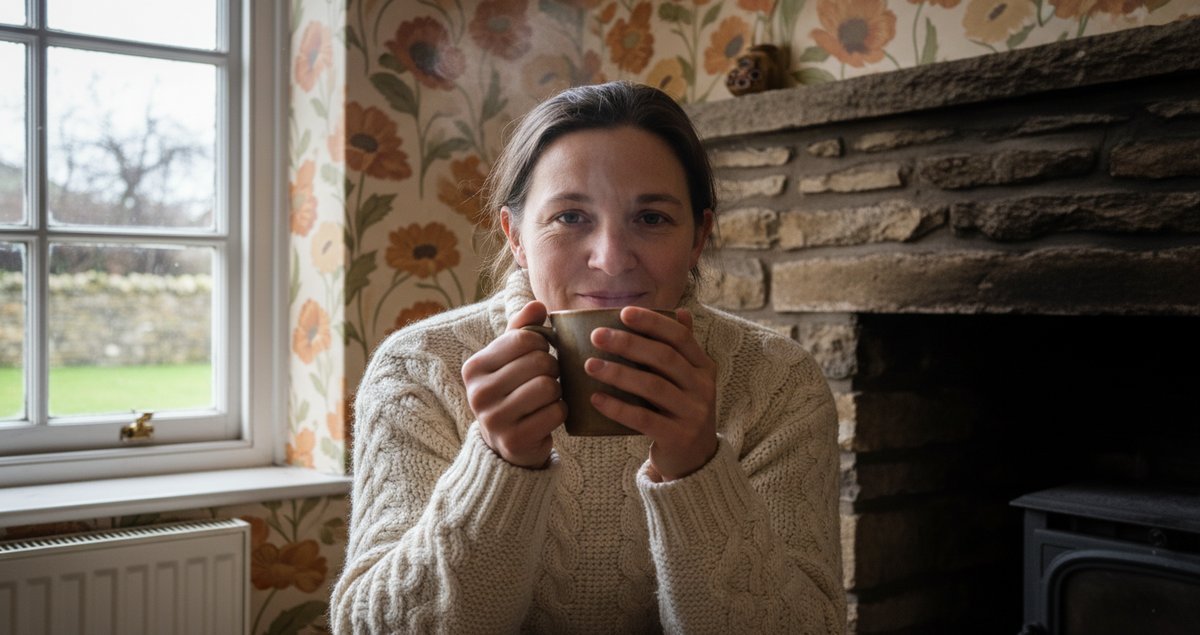
There is a particular stubbornness to the memory of cold houses. People who grew up in the 1970s still talk in clipped sentences about draughts and single fires and the ritual of layering clothes. Those recollections tend to frame the decade as a time of shivering scarcity. But the truth is messier and far more interesting. How homes in the 1970s kept warm with less heating is not just a catalogue of thrift and suffering. It is a story of design choices household ritual and modest technologies that squeezed comfort from very little energy.
Small hearths big behaviours
In many British homes the hearth was the calendar and the thermostat was a mood. Instead of heating an entire house as a background constant families prioritised one or two occupied rooms. The living room was the social engine. People gathered there. Meals homework and sleep routines orbiting a single source of warmth meant that the nominal temperature of the whole house could be lower without anyone feeling permanently uncomfortable. This was a culture of proximity not of ambient control.
This was intentional and accidental
Some of it was economic necessity. Fuel was expensive and inconvenient to move. Coal sacks and the chore of stoking made profligate warming unlikely. But there were smarter habits too. Thick curtains were drawn at dusk not because of Instagram aesthetics but because fabric acts as a thermal buffer. Rugs were not merely decorative. Door draught excluders were an everyday improvisation. These actions sound quaint today but they reduced heat loss in ways modern households often ignore.
Architecture that helped
Houses of the period often had smaller room volumes than many modern open plan builds. Lower ceilings and compartmentalised layouts create zones that hold heat more easily. Small rooms heat faster and cool slower. Double glazing was not universal but where secondary glazing or internal shutters existed they served the same thermal role wood shutters or heavy curtains deprived windows of their talent for sucking warmth out of rooms.
There is a technical thread here. Heat loss is not linear. Reduce one prominent leak and the house behaves very differently. In several influential projects of the era researchers learned that airtightness and targeted insulation paid far more than simply increasing boiler power. The Saskatchewan Conservation House in North America is a famous example of how sealing and insulation can render a home almost indifferent to conventional heating. Its lessons reached practitioners on both sides of the Atlantic and quietly influenced retrofits in Britain.
It also bothers me a great deal to see the misconception that people have about energy in buildings.
Harold Orr BE59 MSC63 Senior Researcher University of Saskatchewan
Tools people used and why they mattered
Hot water bottles simple electric blankets and insulated thermoses are the sort of domestic tools that do not appear on energy statistics but change behaviour dramatically. Localised heating is efficient because it warms a person directly rather than the surrounding air. This is why people sat under blankets or pulled on extra layers even while a room registered as cold on a thermostat. It is pragmatic intimacy rather than abstract temperature control.
Another important but overlooked device was the humble radiator reflector. A sheet of reflective foil fixed behind a radiator on an external wall sends heat back into the room instead of letting it seep into the wall. Today that trick looks like penny pinching. In many 1970s homes it was a smart way to amplify limited output without more fuel. The principle here is simple and still useful even if the material has been made fancier by modern insulation products.
Behavioral technologies beat brute force
One reason the 1970s feel colder than they were is that modern heating makes the entire house uniformly warm and therefore flattens the signal that told people where to be. When a home is warmed everywhere people drift. In the 1970s the constraint of localized heat forced a kind of household choreography. Parents timed bathwater to use dishwater heat for washing fuel economies meant planning rather than autopilot heating. Ritual became efficiency.
I do not romanticise inconvenience. There were genuine hardships and respiratory issues then that modern housing improvements have relieved. But the social architecture of those homes produced a compactness of energy use often more efficient than the complacent assumption that more energy always equals more comfort.
What we threw away with central heating
We adopted whole house heating in part because it solved real problems. Frozen pipes and damp homes are solved by steady background warmth. But whole house heating also removed incentives for local fixes. People stopped fixing draughty windows because it was easier to turn up a boiler. The result has been insulation gains on paper offset by behavioural drift towards higher baseline temperatures. That is a moral as well as a technical point. Technology solved one set of problems but eroded a culture of attention to small losses.
Lessons that are not being taught in shiny renovation blogs
First do not assume more heat is the first step. Fix the envelope. Stop leaks. Those measures reduce demand and increase the payoff for any heating you do use. Second resist the idea that comfort is uniform. Encourage zone heating and reclaim the idea that bedrooms do not need living room temperatures all night. Third pay attention to materials that age. Some 1970s insulants were problematic but many passive techniques survive and perform.
Relearning these lessons is not a backward step. It is pragmatic. There is also a democratic angle. Low tech measures are accessible to households that cannot afford extensive retrofits. Draught proofing low cost secondary glazing and behavioural adjustments can buy substantial comfort without huge capital outlay.
Some things I suspect but cannot prove fully
I think the nostalgia for the hearth hides a useful truth. People who lived through the transition to central heating became better at tolerating higher ambient temperatures because they translated convenience into habit. That habit raised expectations of what a house should be. Changing those expectations is as much cultural work as it is technical policy. I do not have neat data on how many households would accept lower whole house temperatures in exchange for preserved comfort rituals but anecdote suggests some appetite for rethinking the baseline.
There are also trade offs worth debating. A home heated intensively for short periods will sometimes produce more localized moisture and condensation issues if ventilation is poor. So airtightness needs pairing with controlled ventilation not blind sealing. The best outcomes sit between extremes.
What modern homeowners can borrow from the seventies
Keep the idea of zones. Use local radiant heat where people sit. Invest first in sealing and insulation rather than oversizing a boiler. Consider textiles as thermal technology. And do not underestimate the psychological power of visible warmth like a modest flame or a glowing radiator. Comfort is partly a story your senses tell you about safety and care. That is not a crude illusion. It is a very human engineering input.
The phrase How homes in the 1970s kept warm with less heating should not be read as nostalgia for draughts. It is an invitation to sift the practical durable lessons from the inconvenient past. If policy and popular imagination can combine the envelope first thinking of early energy pioneers with the convenience of modern controls we might get warmth that is both cheaper and more democratic.
Summary table
| Aspect | 1970s practice | Modern takeaway |
|---|---|---|
| Behaviour | Zone centric living and localized heating. | Embrace zones and local radiant sources to reduce overall demand. |
| Architecture | Smaller rooms and compartmentalised plans. | Design or retrofit to create thermal zones rather than single open volumes. |
| Materials | Curtains shutters rugs and reflective foils. | Use textiles and reflective surfaces as low cost thermal measures. |
| Technical | Focus on reducing leaks and targeted insulation. | Seal the envelope first then size heating plant smaller. |
| Culture | Rituals of warmth and scheduled heating. | Recover household practices that encourage efficient use without sacrificing comfort. |
Frequently asked questions
Did people in the 1970s actually feel warmer or was it mostly survival tactics?
They felt warmer in the places that mattered because heat was concentrated. A single warm well used room can create a perception of overall comfort even if other rooms are cold. That is subjective but powerful. The rituals around shared spaces created companionship warmth and a pragmatic tolerance for lower ambient temperatures elsewhere. The strategy worked for the lived experience of many families even though it would fail a modern temperature audit.
Were 1970s insulation materials safe and effective?
Some materials used then were effective while others have since been discredited or found to degrade. Certain foams and loose fill products from the era have been problematic. The more enduring techniques were about sealing gaps creating secondary glazing and using heavy textiles. Those low tech measures remain safe and effective. When dealing with old insulants consult a qualified surveyor rather than guessing from appearance.
Can modern houses realistically use these old strategies?
Yes but with nuance. Zoned heating and local radiant sources can be integrated with modern controls to achieve convenience without waste. However modern airtight constructions require mechanical ventilation to avoid condensation and maintain indoor air quality. The key is marrying the old focus on reducing heat loss with new standards for ventilation and materials.
What is the single most impactful change a homeowner can copy from the 1970s approach?
Seal the obvious leaks. Draught proofing around doors windows and service penetrations often pays back rapidly by improving comfort and reducing on demand heating needs. It is cheap compared to major system upgrades and can change how a home feels overnight. After that prioritise insulating the loft and improving window performance if possible.
Is there anything lost by moving away from 1970s habits?
We gained convenience and a reduction in some health risks but we also lost a culture of energy attention. That loss matters because behaviors drive a large part of household consumption. Recovering selective habits around zonal thinking and textile use may be a low cost way to reduce demand without requiring dramatic infrastructure change.
