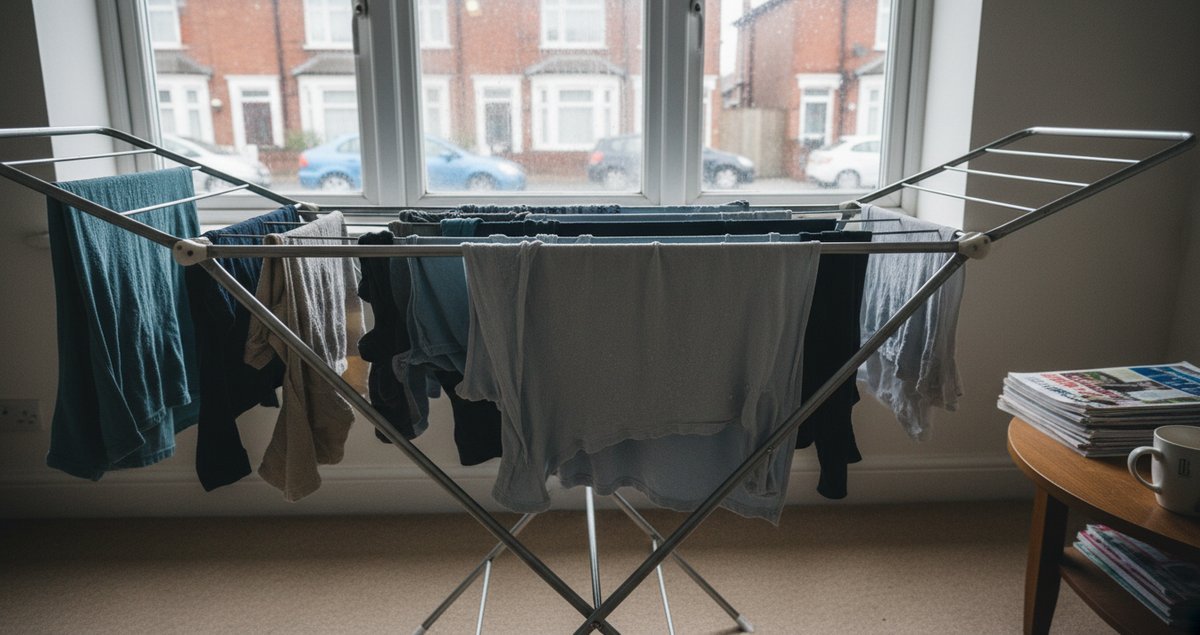
There is a soft domestic choreography every wet-weather season. Nets of laundry sag across living rooms. Sweaters lean on radiators like tired animals. For many in Britain this is less habit than necessity. But does the innocent act of drying clothes indoors quietly increase dust levels and the invisible nuisances that live in our air
What the air in your flat quietly tells you
When a load of washing goes on the airer it releases water into the room. That fact is mundane but the consequences are not. Moisture alters the microclimate of a space. The humidity climbs. Surfaces collect condensation and microscopic life forms notice. Dust mites prefer a certain humidity range. Mould spores flourish on damp patches. Over weeks these small changes can shift what you are breathing without you realising it.
Not just dust in the literal sense
People usually think of dust as what lies on the dresser. But airborne particulates are more complex. Fibres released from fabrics during drying, skin cells, settled dust that is remobilised by movement and increased humidity all mix. Some particles are heavy and settle fast. Others stay aloft. Your indoor drying routine changes that mix.
What research actually found
Academic teams in the UK have repeatedly pointed to indoor drying as an important source of household moisture. One of the clearest studies came from researchers linked to the Mackintosh Environmental Architecture Research Unit at the Glasgow School of Art. They tracked moisture levels and indoor practices across multiple homes and found that drying laundry inside can contribute a notable fraction of a household’s indoor moisture budget. That moisture in turn correlated with conditions favourable to dust mites and fungal growth.
Professor Colin Porteous Researcher Mackintosh Environmental Architecture Research Unit Glasgow School of Art said “Because of increased awareness of the energy consumption of tumble dryers many people are choosing to dry clothes passively within their home. This results not only in a severe energy penalty but also a potential health risk due to higher moisture levels.”
The quote is blunt because the data underpinning it is blunt. From a physics perspective a typical wash can release roughly two litres of water into internal air. The numbers are not dramatic on an hourly basis. Cumulatively they matter. If your home is tight and your ventilation limited the moisture lingers long enough to feed biology and to alter the behaviour of dust.
How indoor drying can alter dust dynamics
Two processes matter most. The first is biological amplification. Dust mites and many mould species prefer higher relative humidity. More humidity means more reproduction and more waste particles from mites which are highly allergenic. The second process is particle release and redistribution. Damp fabrics shed different particles than dry ones and wet laundry increases air currents as it dries. These currents stir dust from bookshelves sofas and carpets and keep it airborne for longer.
Small spaces amplify the effect
In houses with dedicated airing cupboards or gardens the problem is diffused. In one bedroom flats the effect concentrates. You hang a week of washing in the living room and you spend evenings surrounded by the very air that was altered by your laundry. Think about that scene for a moment. The scale matters.
What most blogs miss
Advice columns often split neatly between energy saving and health. They tell you to dry outside when possible or to buy a dehumidifier. That is reasonable but incomplete. The nuance is in the fabrics and the sequence. Synthetics hold water differently than cotton. Detergent residues and fabric softeners can be re-emitted as volatile compounds during drying. The combination of detergent chemicals and elevated humidity may change the stickiness of dust and its chemistry in ways that are not yet fully explored in consumer writing.
I am sceptical of one-size-fits-all conclusions. A small modern flat with mechanical ventilation is not the same as a Victorian terrace with single glazed windows. But the experienced pattern is consistent. Indoor drying nudges your home environment toward conditions that favour more airborne biological material and different dust behaviour. It does not automatically ruin a home. It changes probabilities and creates conflicts for those who are sensitive.
Practical choices that are not obvious
There is a hierarchy of interventions that feels more creative than the usual checklist. Consider the order in which you wash fabrics. Wash gym clothes and heavily soiled items on separate cycles and dry them outdoors if you can. Rotate which rooms you use for drying so damp does not repeatedly burden the same surfaces. Use an airing rack placed near an extractor fan or a window that you can open briefly rather than hanging everything in a corner to languish.
Personal observation tells me people underuse heated airers because they worry about cost. Yet a short burst of active drying and ventilation can reduce the time moisture lingers. The long game is insulation and building design. The short game is tactical drying and mindful sequencing of laundry.
When the evidence still leaves space for doubt
There are unanswered questions. How much of the observed rise in airborne fungal spores is caused by the laundry itself and how much by the water that condenses on nearby walls and then incubates microcolonies There is also variation in individual sensitivity. Some people notice a change in their symptoms almost immediately. Others are unaffected. Science is tidy and cumulative but our homes are messy and idiosyncratic. That tension remains.
What to look for in your home
Watch for repeated window condensation musty smells visible mould spots and increased sneezing or irritation on damp days. Those signals are not definitive but they are informative. If your living area frequently smells stale after a drying session something in the cycle is establishing a microclimate that traps biological material.
Final verdict
Drying laundry indoors can quietly increase dust levels and the biological components tied to dust. It is not a catastrophe for every home but neither is it a trivial stylistic choice. The decision to dry inside or outside is layered with energy considerations housing design and individual sensitivity. I lean toward caution in small poorly ventilated homes. The simplest shifts often have the largest effect. A short burst of ventilation a rearranged drying sequence or occasional outdoor drying reduce risk without dramatic cost.
Summary table
What happens Increased indoor humidity and altered particle mix.
Immediate consequences More airborne fibres and remobilised settled dust.
Medium term Conditions that favour dust mites and mould colonies on cool surfaces.
Most affected homes Small poorly ventilated flats and rooms used repeatedly for drying.
Practical levers Rotate drying rooms ventilate briefly after drying sequence separate heavy loads and use timed active drying if available.
FAQ
Does drying laundry indoors always increase dust levels
Not always. The effect depends on the volume of drying the ventilation rate the thermal envelope of the building and the fabrics being dried. In a well ventilated home with intermittent indoor drying the change may be negligible. In compact airtight flats with frequent indoor drying the environment can shift in ways that increase airborne particulate matter and biological contributors to dust.
Are certain fabrics worse for indoor drying
Yes. Synthetics such as polyester release moisture differently and may retain odours longer which encourages prolonged drying. Towels and heavy cottons shed more fibres during drying and can release larger amounts of particulate as they dry. Residues from detergents and softeners also matter because they alter the chemical nature of what becomes airborne.
Will a dehumidifier fix the problem completely
A dehumidifier helps by removing moisture from the air which reduces the conditions favourable to dust mites and mould. It is not a cure all. Placement airflow and maintenance of the device matter. If condensation forms on cold surfaces those spots can still support mould which a dehumidifier may not immediately eliminate without cleaning and airflow changes.
Is indoor drying more of an issue in British homes than elsewhere
The combination of rainy seasons smaller living spaces and a cultural tendency to economise energy makes indoor drying common in Britain. The underlying physics is global but local housing stock and lifestyle patterns can amplify the issue here compared with places where outdoor drying is easy and widespread.
How do I judge if my home is at risk
Watch for persistent condensation musty smells visible mould and any pattern of increased sneezing or irritation after drying sessions. Frequent reappearance of damp spots near where laundry dries is a clear sign that moisture is affecting surfaces long enough to foster biological growth.
